This chapter probes how Libanius and John Chrysostom dealt with Antioch’s past in their conceptualization of the city. In Late Antiquity, Averil Cameron aptly writes, “the past was so real that it was subject of intense competition.”[1] The writings of both authors strongly corroborate this statement. They constantly employed, manipulated, and reinterpreted the city’s history while forming contesting ideals of their own regarding Antioch. Libanius featured in his writings the Hellenistic history of the city and Greek myths[2] associated with it. He engaged with the already-existing traditions, myths, and narratives. Hence, his ideal of Antioch was drawn from the traditional repertoire of gods, mythical heroes, and quasi-mythical historical narratives of Antioch’s Hellenistic past. His interpretation of the city’s history mostly omitted narratives other than these. Even the Roman history of the city was overshadowed, and Christianity does not find a place in his writings beyond some vague implications.[3] We will see how he promoted Greek myths in his narratives about the time predating the actual founding of the city by Seleucus Nicator. In a way, according to him, these narratives revealed how the city’s pre-history and Hellenistic past had pointed to the city’s fourth-century grandeur and how, from the very beginning, Antioch was the chosen place of Greek heroes and Olympian gods, Antioch’s prosperity was tightly connected to the favor of these gods. These gods had always favored Antioch and protected her. In contrast, in John Chrysostom’s vision of Antioch, the Christian God replaced these Greek gods. Chrysostom’s narratives, opposing Libanius’ conceptualization, portray Antioch as a Christian city. Contrary to what Greek myths pointed to, in John Chrysostom’s narratives, Antioch was a city chosen by the Christian God, and Greek heroes are replaced by saints and martyrs who draw their strength from God. In this conceptualization, this time, it was not the gods who guaranteed the prosperity of Antioch, but the Christian God and his saints and martyrs. Chrysostom had a conceptualization of a city which is the stronghold of Christian religion, guarded by the one and true Christian God.[4]
Devamını oku: Constructing Narratives and Fourth Century Antioch: History, Memory, and Myths
3.1 Abode of gods: Antioch’s mythical past according to Libanius
Libanius constructs an image of Antioch as the quintessential Greek city, a concept that stands in stark contrast to the contemporary reality of a burgeoning Christian city. He posits a narrative of unbroken continuity from the city’s mythical past to its present situation, arguing that the qualities that ennobled Antioch in its pre-history and far antiquity continued to exalt it in the present.[5] This perspective prioritizes the city’s Hellenistic heritage, with its roots firmly planted in mythology. In this regard, the constructive role of the myth and the lineage it set is evident in Libanius’ efforts to forge an identity for Antioch.[6] Libanius’ Oration 11, The Antiochikos, exemplifies this strategy,[7] a stark counterpoint to Chrysostom’s focus on incidents regarding Christianity and the acts of saints.
Through this mythical account,[8] Libanius establishes a connection to his conceptualization of the city with mythological past of it. He narrates how Io, disguised as a heifer by Zeus, aiming to keep her distant from Hera’s anger after the latter had found out about the affiliation, reaches the site of future Antioch.[9] The people of Argos (Argives), sent to find Io, are so captivated by the location and its hospitable inhabitants that they abandon their mission and settle there.[10] In another oration, he employs the same story: “Our city claims descent from the race of Inachus that wandered far in search of Io (…).”[11] Thus, the Argives, led by Triptolemus,[12] after they had established a city called Ione in honor of the lost daughter of Inachus and built a temple to Zeus Nemeios,[13] became the first settlers of future Antioch.[14] Libanius, in this account, deliberately downplays the indigenous population who had occupied the land before the arrival of the Argive Greeks and, having taken a passive stance, accepted them well.[15] Accordingly, only after the Greeks had settled on the territory where the future Antioch would rise, and hence, with its acquisition of Greek identity, its history began.[16]
With this account, Libanius directly links the foundation of Antioch to Zeus,[17] who, with his chase of Io, caused her wandering and hence became responsible for the foundation of future Antioch and, from then on, assumed the role of its protector. From that moment on, Zeus, “by whose approval the city was begun,” desired Antioch to have the best lineage and nudged Casus to go there from Crete. Cretans followed him and Casus founded Casiotis.[18] Casus also encouraged some Cypriots to come and settle in the region of future Antioch after he had married the daughter of Salamenus,[19] the ruler of Cyprus.[20] Libanius, having formed a lineage stemming from Argives, Cretans, and Cypriots, further relates that some of the Heraclidae,[21] along with some Eleans after their wandering caused by Eurystheus, installed themselves in the region and found another town named Heracleia.[22] Thus, according to Libanius, the first stock of Greek settlers in the region of Antioch and roots upon which future Antiochenes would thrive is completed:
(…) the best and noblest from all these sources flowed together here, as though to a place divinely appointed to receive men worthy of admiration. These roots united their several virtues in us alone – the ancient lineage of the Argives, the law-abiding nature of the Cretans, the royal ancestry of Cyprus, and the divine descent from Heracles.[23]
Later on, Athenians and other Greeks would be added to this thread of Greek ancestry.[24] However, this depiction shows well in advance that Libanius envisioned Antioch from the very beginning of its foundation as an epitome of Greek civilization or a beacon of Hellenic culture amidst a “barbarian” world, with a fine stock of Greek settlers who were carrying out their traditions:
The inhabitants of Ione then, (…) bestowed upon the gods their proper due; in all happiness they inhabited a Greek city (πόλιν Ἑλλάδα) in the midst of heathendom (ἐν μέσῃ τῇ βαρβάρῳ). They had and maintained their manners pure (…).[25]
This account of the foundation of three different towns in the region of future Antioch and its suburb Daphne and the genesis of a fine Greek ancestry for the Antiochians in Libanius’ Antiochikos transcends mere historical reflection. Beyond whether or not Libanius believed that this was exactly how these things had unfolded, this oration and the quasi-historical narrative in it functioned as a tool for constructing a normative discourse. Through its paragraphs, Libanius prescribed a set of ideals that he believed the city’s inhabitants should have embraced to preserve its enduring dignity that stemmed from Antioch’s Greek past. The oration specifically targeted the audience gathered for the Olympic games in Antioch in 356 AD.[26] For Libanius, they were not simply spectators but inheritors of this Hellenic past, the virtues of whose heroes they should have imitated. Only an unwavering adherence to the traditional way of life would ensure the favor of the gods, who favored Antioch from the very beginning: “The place was beloved of the gods from the start.”[27]He composed this oration in the context of a tide of immense changes, yearning for an imagined golden age. His conceptualization of Antioch was one of seamless continuity, where the city’s past glory was directly linked to its present condition, perpetually nourishing the city’s core values in the fourth century. Adhering the traditional values to ensure divine protection was another tenet in his perspective on Antioch’s identity.
The language of divine favor is a readily employed rhetorical device in the works of Libanius. In Oration 11, which he possibly delivered in front of a large number of Christians (as well as the adherents of the Greco-Roman religion),[28] he spelled out that Zeus had bestowed his blessings upon Antioch and become his founder.[29] This perspective serves a dual purpose: it reinforces the city’s image as a place chosen by the god(s) and strengthens its connection to the pantheon of the Greek gods. In this regard, Libanius’ narration extends beyond suggesting merely divine favor. He further exalts Antioch to a level comparable to Mount Olympus, the legendary dwelling place of the Greek gods. He claims that while Olympus exists only in the realm of poetry, Antioch’s divinely sacred location, nonetheless, is readily apparent to all who behold:
Our city was a dwelling-place of the gods so that if we so desired, we could set up in opposition even to Olympus, for the residence of the gods there is a poets’ tale, while the proof of their sojourn here is the evidence of our senses. Fresh occurrences[30] came about with the lapse of time; for instance when the sway of Rome became supreme, the presence of the gods remained in the city’s possession, and they experienced, in relation to Zeus Cassius, (…) They removed his statue, but he hurled his bolts upon everything and harassed them to ensure his return, and he made them change their minds.[31]
This audacious claim positions Antioch not simply as a city favored by gods but as a potential rival to the very seat of the gods, Mount Olympus, hence further adding another layer to Libanius’ conceptualization of Antioch.
Libanius further intertwines mythology with civic identity of Antioch by associating city’s agricultural prosperity with the beneficence of Greek deities. He credits Dionysus, the god of wine and festivity, with ensuring the city’s wine harvests. Similarly, he attributes the fruitful olive groves to the blessings of Athena. By weaving these deities into the narrative of Antioch’s agricultural affluence, Libanius reinforces the idea that the city’s prosperity is not merely a result of the fertility of the soil of the surrounding region but also a direct consequence of the reverence accorded to the Greek pantheon: “There is no lack of anything which, if present, would be an improvement. If you mention Dionysus, he revels in our midst; if Athena, the earth is luxuriant with her olives.”[32] Similarly, he alludes to Antioch’s grain harvest, stating that Demeter favored the soil of Antioch more than that of Sicily. Such was her affection that, while Hephaestus placed only a single golden furrow on his shield, Demeter adorned a vast expanse of Antioch’s soil with golden corn that could be found nowhere else.[33]
The idyllic image of Antioch as a haven for the gods reaches its zenith with Libanius’ description of Daphne. He portrays Daphne as a location so sublime that, were the gods ever to descend from heaven, it would be their chosen venue for their gatherings. This sumptuous praise underscores the centrality of Greek mythology in Libanius’ vision of Antioch and its environs: “If the gods really do leave heaven to visit the earth, here I think is the place for them to gather in assembly, for they could stay in no spot more beautiful.”[34] Considering how Libanius associated the city’s prosperity with Greek gods and explained its historical identity through Greek mythology, it is evident that there is a stark contrast between him and Chrysostom, because Chrysostom presents a singular deity – the Christian God – as the architect and benefactor of Antioch’s prosperity. He emphasizes God’s role in “correcting and restoring” the city,[35] suggesting a divine intervention that guided Antioch on its path to becoming the genuine and staunch center of Christian faith. Nevertheless, it should be noted that Libanius appears to be aiming not only to depict Antioch as a city cherished and protected by the pagan gods in contrast to a city beloved and safeguarded by the Christian God. More significantly, we can observe how skillfully Libanius utilizes the rhetorical principles outlined by Pseudo-Menander to shape this portrayal of Antioch. In a section discussing how cities should be praised for their achievements, Pseudo-Menander emphasizes the significance of piety towards the gods. This concept of piety encompasses both being loved by the gods and reciprocating that love. Cities such as Athens, Rhodes, Corinth, and Delphi are cited as examples of cities loved by the gods. For instance, while Athena and Poseidon vied for Athens, Hellas and Poseidon contested for Corinth. Traditionally, Athens is closely associated with a variety of gods including Dionysus, Apollo, Poseidon, Athena, Hephaestus, and Ares.[36]Libanius rhetorically argues that Antioch is on par with these cities and even surpasses them.[37]
3.2 Christian history of Antioch according to Chrysostom
John Chrysostom presents a narrative of Antioch’s past that features its Christian heritage. To such an extent that, as Wiemer has noted, for Chrysostom, the history of Antioch begins with Paul’s visit to the city, and the name Christian was first given to believers in this city.[38] His sermons, particularly the homilies in the series Ad populum Antiochenum, (On the Statues) offer an effective challenge to the Hellenic narratives propounded by Libanius. Chrysostom utilizes a powerful rhetorical approach to establish Antioch’s preeminence within the Christian world. In his 17th homily of On the Statues, he emphatically declares, “Dost thou wish to learn the dignity of thy city? Dost thou wish to know its ancestry? I will tell it exactly (…).”[39] He then proudly proclaims that Antioch holds unique merit and distinction among all other Christian cities: it is the birthplace of the term “Christian” itself and he further adds: “This dignity, none of the cities throughout the world possesses, not even the city of Romulus herself!”[40] This reference to the biblical event where followers of Christ were first called Christians in Antioch becomes a recurring theme and source of boast in Chrysostom’s writings.[41] By repeatedly highlighting this episode, he emphasizes the city’s pivotal role in the development of Christianity. This association with the very origins of Christian identity elevates Antioch’s status and grants it a leading role among other Christian centers, hence it becomes one of the first tenets of Chrysostom’s conceptualization of Antioch.
It is worth noting that, for Chrysostom, the reasons or historical context behind the first application of the name “Christian” to believers in Antioch did not seem to be significantly important. We could speculate that Chrysostom had pondered this question or even had an opinion on the matter. What was the event behind the incident described in Acts 11.26? Did the Christians give themselves this name, or did they adopt it from an external source? If the name was not originally theirs, who coined it? Who did it represent at the time it was created? When did this name become widely accepted? What mattered most to Chrysostom was the outcome and the reality as recorded in the Acts: the name Christian first emerged in Antioch and subsequently spread throughout the world.[42]
He positions Antioch not simply as a place where Christianity took its first steps but also as a source of faith that nurtured and disseminated Christian ideals throughout the world: “(…) this good work, having taken its root and starting-point from hence, will make all men that inhabit the earth your disciples (…).”[43] John Chrysostom elevates the city to a far more transcendent status – a “heavenly” one[44]-based on its vital role in Christian history. Chrysostom emphasizes this essential role through a powerful metaphor. He asserts the “fountain” from which the waters of Christianity overflowed had emerged at Antioch and from thence reached all corners of the world. Just as in Libanius’ narrative, the city’s Hellenic past imposes certain responsibilities on the Antiochians, we see the same theme repeated in Chrysostom’s homily. Since being the citizens of where this “fountain” of Christianity was located, by becoming exemplary Christians -or instead, Chrysostom called them “disciples”- Antiochians should have taken on the responsibility to guide others:
Yea, rather, should this be done, [if the people of Antioch stop swearing] she [Antioch] will not be herself crowned alone, but will also carry others along with her to the same pitch of zeal. And as the name of Christians having had its origin here, hath as it were from a kind of fountain overflown all the world, even so this good work, having taken its root and starting-point from hence, will make all men that inhabit the earth your disciples; so that a double and treble reward may arise to you, at once on account of your own good works, and of the instruction afforded to others. This will be to you the brightest of diadems! This will make your city a mother city, not on earth, but in the heavens![45]
John Chrysostom’s De sancto hieromartyre Babyla (On the Holy Martyr, St. Babylas), provides another rich resource for understanding the construction and consolidation of his Christian conceptualization for Antioch during this period. This sermon moves beyond the historical recounting of the events that happened during Julian’s visit to Daphne, and it serves as a powerful tool in assessing Chrysostom’s interpretation of the events for the good of his conceptualization.
Chrysostom employs a deliberate strategy to elevate St. Babylas to a position of central importance. He highlights the “noble deeds of the martyr”[46] as the essence of the city’s sacred character. By attributing a special holiness to Antioch due to the presence of St. Babylas’ relics, Chrysostom aligns himself with the increasing veneration of relics in Late Antiquity.[47] However, simultaneously, he bolstered his conceptualization of Antioch as a distinguished Christian city housing the physical remnant of this martyr and saint who possessed potent spiritual power capable of sanctifying its surroundings. The homily further emphasizes the significance of the relics of St. Babylas through the dramatic narrative regarding the return of his relics from Daphne and their reception by the Antiochian population. Chrysostom portrays the emperor Julian as one “who surpassed all in impiety”[48] since he had ordered (by the commands of the oracle of Apollo, “the prophet, the great God of the Greeks,”[49] as John Chrysostom calls him) the dead body of St. Babylas to be moved from Daphne, and his attempt to remove the remnants as an act of outrageous sin:
What could be more impious than these commands? The Demon of grave-robbing introduces strange laws and devises new methods of expelling strangers. Who ever heard of the dead being driven forth? who ever saw lifeless bodies ordered to be moved as he commanded, overturning from their foundations the common laws of nature.[50]
Chrysostom employs vivid imagery to depict the Antiochians’ response upon the relics’ return to the city (when he was around 15 years old). He describes deserted marketplaces, houses devoid of women and young girls to welcome the saint:
For then, when he [Babylas] returned from Daphne, all our city poured forth into the road, and the market places were empty of men, and the houses were empty of women, and the bedchambers were destitute of maidens. Thus, also every age and each sex passed forth from the city as if to receive a father long absent who was returning from sojourn far away.[51]
This account underscores the concord of Antiochians in welcoming the saint’s relics, suggesting that every citizen participated in this sacred cortege. The busy marketplace stood empty, highlighting the unusual nature of the occasion. Homes are depicted as devoid not just of people but specifically of women and young girls, further emphasizing the collective response of Antiochians and, hence, the city’s virtuous and sacred character.
Moreover, Chrysostom’s language is carefully chosen. He relates that the Antiochenes welcomed St. Babylas as if they welcome their fathers. This evocative comparison exalts the martyr beyond being a mere historical figure, positioning him as a revered spiritual father and protector of the city. The image of the city united in welcoming their spiritual father suggests a strengthened bond between the Antiochians and the saint and implicitly leaves no space for adherence to pagan practices. Therefore, with this account, Chrysostom bolsters his conceptualization of Antioch as a leading Christian city.
Chrysostom utilizes the story of St. Babylas to construct a narrative of decisive Christian triumph.[52] He portrays St. Babylas as not only conquering Julian but also vanquishing the pagan deity Apollo. Chrysostom emphasizes the universality and all-encompassing nature of this victory, telling its resonance within Antioch’s past, present, and future inhabitants:[53]
For the walls [i.e., walls of the ruined temple of Apollo] are now standing, instead of trophies, uttering a voice clearer than a trumpet. To those in Daphne, to those in the city, to those who arrive from far off, to those who are with us, to those men which shall be hereafter, they declare everything by their appearance, the wrestling, the struggle, the victory of the martyr.[54]
Through this evocative language, Chrysostom effectively transforms Daphne into a sacred Christian space through the presence of the saint’s relics and even their absence, as well as he underscores the saint’s victory over traditional Greek religion.
This version of events sharply contradicts the portrayal Libanius provided some thirty years before. Libanius portrays Daphne as a sanctuary of Hellenic culture. He meticulously details the presence of temples dedicated to Apollo and Zeus, an Olympic stadium, and a theater – all hallmarks of the Greek world. In his writings, he describes it as a dwelling place for nymphs. He even goes so far as to claim that Daphne served as the location for the mythical Judgment of Paris,[55] further solidifying its association with the Greek pantheon.[56] Libanius’ lavish praise for Daphne’s natural beauty further reinforces its idyllic status within his idealized Hellenic framework: “Of this too I am convinced, that when the three goddesses began to quarrel about their beauty, it was here that they came to bathe for the judgement, rather than to the place where the story has it.”[57]
3.3 Local traditions of Antioch: Orestes and Alexander the Great
One of Libanius’s most notable adaptations of a well-known Greek myth to the Antioch setting is the story of Orestes.[58]Malalas also relates the story of Orestes, with its distinctive Antiochian variant, indicating the persistence of the local variant of this story in the sixth century. But for the moment, what matters is how Libanius, in his own narration and reinterpretation of this story, was able to link Antioch’s prehistory with Greek mythology.[59] He was able to connect the region that would become Antioch with the Homeric heritage and the Classical Greek tragedies by means of Orestes’ story. Furthermore, through Orestes’ ancestry, and the foundation account of Ione in the vicinity of future Antioch, the version of the legend used by Libanius creates a connection between Antioch’s mythology and pre-history with Zeus.
As the tradition puts it, Orestes was the son of Clytemnestra and Agamemnon, son of Atreus, thus belonging to the house of Atreus by his father’s side. Atreus was the son of Tantalus, who, in turn, was the son of Zeus.[60] After the Trojan War, Agamemnon was murdered by his wife, Clytemnestra, and Aegisthus, her lover. Orestes was sent away to escape his father’s fate. However, Apollo convinces him to take his father’s revenge after Orestes grows up. Thus, he returns to Mycenae and kills Clytemnestra and Aegisthus[61] with the help of his sister Electra, whom he meets in front of the tomb of Agamemnon, according to the story told by Aeschylus.[62] After committing the act, Orestes becomes insane and is chased by the Erinyes, whose responsibility is to penalize any transgression of familial bonds. Athena brought him to the Acropolis of Athens to be judged by the twelve gods. The Erinyes wanted him to be punished, but Orestes claimed that he was following Apollo’s orders. The judges’ votes are tied, and Athena casts her vote for acquittal. Although Aeschylus’ tragic narrative concludes at this point, Euripides’ narrative continues further. Apollo commanded him to go to Tauris to flee from the persecutions of the Erinyes. His mission was to bring the statue of Artemis, which had fallen from heaven to Athens. Upon their arrival at Tauris, Orestes, and Pylades, his companion, were taken captive by the locals who followed a tradition of sacrificing foreigners to Artemis. Iphigeneia, Orestes’ sister, was the priestess of the Artemis cult in Tauris. During the sacrifice ceremony, Iphigeneia offers Orestes his freedom in exchange for delivering a letter to Greece. However, they eventually recognize each other and escape together with the statue of Artemis.[63]
Classical Greek tragedians do not further narrate their wandering before their final reach into Greece. However, both Malalas’ account and Libanius’ writings testify to the local variations of the same story.[64] For Libanius, or according to the local myth he employs in his Oration 11, Orestes seems to have come to the territory of future Antioch. In the paragraphs (§175-176) in which Libanius eulogizes the hospitality of the land of Antioch, he tactfully attributes a role to the territory of Antioch in this famous Greek tale. As per the account of Libanius, Orestes, who was afflicted with madness by the Erinyes and forced to wander, was cured of his ailment upon reaching the territory of Antioch. So, the region was so hospitable, therapeutic, and tranquil that even Orestes, famous for his madness, could regain his sanity only after coming here:
Even Orestes, after the murder of his mother, when he raged through the rest of the world hotly pursued by the deities who imposed the punishment of madness on the lad, was restored to his senses once more by our land. As soon as he entered our territory, his madness left him, and the event gave the name to the place.[65]
Through these sentences, Libanius not only commends the therapeutic and calming nature of Antioch’s geography but also imbues the city with a role in the renowned tale of Greek mythology. Additionally, he establishes a link between Zeus and the city’s history via the genealogy of Orestes, highlighting Antioch’s significance in the Hellenic world well before its establishment. It is worth noting that despite discussing the mythological story of Orestes at length in his Declamation 6, Orestes in which he ostensibly defended Orestes in the trial as if Orestes is speaking for himself, Libanius did not mention Orestes’ wanderings in the territory of Antioch. [66] A more fitting location for such a reference would be in Oration 11, where he proudly expresses his civic pride and shares his vision of Antioch.
Another example of Libanius adapting a well-known story to a local Antiochene setting comes not from classical mythology and tragedies, but from semi-historical fictions. While Alexander the Great features prominently in Libanius’ historical narrative of Antioch, no known ancient sources chronicling Alexander’s Persian campaign, initiated in 336 BCE, mention him visiting or attaching significance to the future site of the city, following his victory at Issus in 333 BCE against Darius III.[67] However, a distinct local tradition regarding Alexander’s connection to Antioch existed.Downey acknowledges the debate surrounding Alexander’s alleged visit yet also further stresses the existence of a local etiological tradition that glorifies the city’s origins.[68]
Further evidence of this local tradition emerges from an anonymous epigram within the Anthologia Graeca(Palatine Anthology). This epigram tells how Alexander the Great, having reached the area, drank from a spring, likened its water to his mother’s milk, and bestowed upon it the name “Olympias” after his mother:
From this fountain Alexander of Macedon drank splendid water, and said its streams were like his mother’s milk. Hence he named it Olympias, as this stone testifies. [69]
Throughout his texts, Libanius frequently emphasizes Alexander’s divine origin as the son of Zeus.[70] Although it is debatable if Libanius truly believed in this divine origin, it is evident that his narrative purposefully benefits from it. As was previously mentioned, Orestes’ lineage can also be traced back to Zeus, which promotes Antioch’s unique status. Alexander’s military expeditions are interwoven with the history of Antioch in Libanius’ account of the city’s origin. After defeating Darius III in the Battle of Issus in 333 BCE, Alexander marched southward in the direction of Phoenicia. Along this route, he paused in the region that would later become Antioch, drawn to a spring with exceptionally sweet water. The taste of the spring water reminded him of his mother’s milk, prompting him to name the spring after her, Olympias, and construct a fountain in its honor.[71] Alexander planned to establish a city in the area because he was so captivated by its beauty. But he was compelled to abandon the place due to the necessities of his military expedition. Prior to his departure, he erected a sanctuary honoring Zeus Bottiaios, a god connected to his native Macedonia. This bolstered Antioch’s Greek-Hellenistic origins further, since the cult’s name came from Bottiaeis, a Macedonian province that in the Roman period was called Emathia. According to Libanius’ narrative, Alexander also built a citadel and called it Emathia, a name that evokes his homeland.[72] Libanius claims that Alexander’s decision indicated that he preferred this area to his own homeland and that he intended to return there and establish his capital:[73]
Such then was the prelude to the foundation of the city; the reputed son of Zeus was reckoned as one of our founders and gave evidence to the report by his actions. Then he soon was taken up to his father [Zeus] and was unable to complete his ambition.[74]
Libanius goes further from Oration 11 in associating the founding of Antioch with Alexander the Great. He strategically employs this narrative in other panegyrics to bolster the city’s image and heritage. In Oration 15, addressed to Julian, Libanius compiles a list of assertions concerning the origins of Antioch, with a particular emphasis on the city’s relationship to both Alexander and the Macedonians.[75] In Oration 17, The Lament Over Julian, Libanius asserts that Antioch was not only the capital city of Antiochus but also it was the city of Alexander, accentuating its beloved status for him.[76] In another oration about the Riot of Statues, which was addressed to Theodosius, he includes a brief paragraph discussing the history of the city and its accomplishments, in which he also recalls Alexander. However, for this oration, determining whether Libanius employs purely rhetorical strategies or genuinely express his own thoughts on the conceptualization of the city presents a challenge.[77]
Libanius’ writings also abound with stories concerning Antioch and its surroundings. This study focuses not on the historical accuracy of these narratives but on how Libanius, in contrast to Malalas, consistently portrays Antioch as a divinely favored and sacred space of gods. This depiction provides the vital component of his conceptualization of Antioch and the message he aims to communicate to his audience. According to Libanius, Antioch and the surrounding region have been always protected by Greek gods and heroes since its earliest days and this divine patronage began well before the city’s official founding -as shown above. In a sense, Antioch becomes, for Libanius, the holy city of the Hellenic world. This sacred character of the city and its surrounding geography was revered not only by figures of Greek mythology and history and their descendants but also by others. Libanius employs an anecdote to illustrate this wider reverence for the region, even predating the actual foundation of Antioch.
He contends how Antioch was venerated even by the Persian gods (τοῖς Περσῶν θεοῖς), but even before that by the Assyrian gods (… Ἀσυρίοις).[78] To prove this, he recounts the story of Cambyses’ campaign to Egypt (525 BCE).[79] According to Libanius’ narrative, Cambyses’ wife, Meroe, accompanied him on this expedition.[80] While traversing through the area that would later become Antioch, Meroe encountered a temple dedicated to Artemis, built by the legendary Assyrian queen Semiramis.[81] Seeing the dilapidated state of the temple’s roof, Meroe convinced Cambyses to have it restored. The Persian king not only repaired the roof but also made the temple itself exalted by adding walls and constructed an enclosure suitable for festivals. He even named the festival held there after his wife.[82] Furthermore, Meroe endowed the temple with an estate (κλῆρος) and appointed female attendants tasked with maintaining the site, providing the temple with various Persian luxuries. Following these restorations, a delegation from the nearby city of Ione arrived before Cambyses. He asked about their identity and the reason for encroaching on his land. On discovering their identity, Cambyses, behaving as if he owed the inhabitants of Ione an obligation of gratitude for occupying his territory, dismissed them without hostility. According to Libanius, this particular story serves as a perfect example of the heavenly protection bestowed on the people who inhabit the region. He claims that while one might talk about the cruelty of Cambyses,[83] this very encounter alone demonstrates how the ancestors of the Antiochians enjoyed divine favor. Even a tyrannical ruler like Cambyses, who reveled in cruelty, refrained from harming them as they were under the protection of the gods, even going as far as to restore the temple of Artemis within their territory.[84]
Libanius’s works, although evidently infused with a wistful yearning for the past – an attitude that his contemporaries also criticized him for[85] – yet reflect a man deeply intertwined with the fabric of his time. He, albeit a dedicated follower of the Second Sophistic school,[86] possessed a keen awareness of the evolving socio-political environment around him. As Sandwell’s study aptly indicates, Libanius effectively navigated these developments during his time by skillfully manipulating them in his writings.[87] His writings often express a genuine longing for a time when city councils had more power and civic governance operated independently.[88] Despite his nostalgia, he pragmatically accepts his position as a Roman citizen and the ultimate authority of the Roman legal and political system.[89]
Remarkably, he reveals a conspicuous reluctance in narrating the history of Antioch during the Roman period in Oration 11, where Libanius recounts the history of his city. The oration provides a thorough account of the city’s Greek and Hellenistic origins and the subsequent reign of the Seleucid rulers. However, it only briefly describes the Roman period, with only a few vague phrases. The acquisition of Syria by Pompeius Magnus (Pompey the Great) in 64 BCE was an essential turning point for Antioch. However, Libanius chooses to gloss over this with just a few sentences.[90]According to him, the Roman annexation is a result of a broader, divinely ordained transfer of power.
This perspective suggests that Antioch, instead of passively succumbing to Roman conquest, actively embraces its new position within the Roman realm. The city submits not to Roman dictates but rather to the will of the gods. Libanius himself expresses this sentiment: “Even if she had opposed it, it was destined that she should be their subject, and so she acceded to them peacefully, and made the future free from bitterness, providing no excuse for rancour.”[91] Although Roman rule was believed to be unavoidable by Libanius due to the divine will, his account conveys an enduring sense of sorrow and regret. Antioch, formerly known as the capital of the Seleucid monarchs, was symbolizing the grandeur of the Hellenistic period. Libanius definitely laments the city’s decline from its former position of dominance. Nevertheless, he argues that Roman rule did not result in immediate unrest. According to him, the new leaders honored Antioch’s customs and status, while also integrating their own customs into the city’s fabric.
In addition to upholding traditions, Libanius considers Antioch’s keeping of its position as the “metropolis” [92]of Asia[93] (μητρόπολις τῆς Ἀσίας) under Roman control to be essential. This continuity helps to downplay the impact of the political change in his account. According to the Libanius’ idealized visualization, that change in administration does not fundamentally modify the inherent characteristics of Antioch, which principally originated from the divine favor it had been enjoying. Libanius acknowledges the Roman takeover but considers it to be of minor importance in the greater narrative of the city.[94] Succinct remarks on the Roman rule are a clear indication of his vision for Antioch. He envisions an Antioch where the essential elements of Greek civilization outweighed the political authority. Antioch is regarded as a sacred place where Greek traditions were being upheld and upon which divine favor was always bestowed:
(…) It was as if there was no difference between the founders of the city, and those who had come to control it, and as if the Romans possessed something they had originally built, and preserved the kindly relationship towards something of their own creation. They guarded its existing fame, and adding their own customs they retained it in its position as the metropolis of Asia.[95]
It is significant to note that Libanius was not a historian but a rhetorician who tailored his account for a specific audience. To draw out the striking differences between his representations of Antioch in the Hellenistic and Roman periods, it is essential to look at how Libanius interpreted the city’s establishment. His sources for these quasi-historical anecdotes involving history mixed with mythology are unknown; however, he depends on long-established traditions of Antiochians. Irrespective of his source materials, he cleverly adapts them to fit into his agenda by selectively including or omitting information. The central part of this agenda involves a persistent emphasis to envision Antioch as being the most significant Greek-Hellenistic city.
Before examining Libanius’ account of the foundation of Antioch, it is helpful to analyze the impact of local tradition within the broader region.[96] An illustrative example is a bas-relief that was published by Henri Seyrig in 1940 (Figure 3).[97] This relief, crafted on a Corinthian style white marble capital, is now exhibited in the Beirut Museum. Seyrig states that it was unearthed in an area approximately 20 kilometers north of Laodicea, a Seleucid city founded around the same time as Antioch. Seyrig assigns the relief to the early to mid-fourth century CE based on its stylistic characteristics. The central composition features a smoking sacrificial altar. To its right stands a crowned goddess, holding a vessel and offering libations. A diadem adorns her crown, surmounted by a distinctive tower rising in the form of a polos. In her other hand, the goddess grasps a statuette of a nude Apollo holding a lyre. A band of laurel leaves encircles her head. Based on the diadem, crown, and statuette, Seyrig convincingly identifies this figure as Tyche, the goddess of fortune. On the opposite side of the altar stands a beardless male figure wearing a short tunic and cloak with a crown of leaves on his head. With one hand, he drags a reluctant bull towards the altar while the other hand prepares a libation. On the center stage behind the altar stands a figure of Victory. Clad in flowing drapery, Victory reaches out to bestow another crown upon the male figure’s head. As Seyrig astutely observes, the man’s attire suggests a Greek rather than a Roman general. Above Victory, though partially obscured by corrosion, a discernable eagle soars to the left, clutching an ox head in its talons. According to Seyrig, these combined motifs evoke the very legend of Antioch’s foundation.[98]
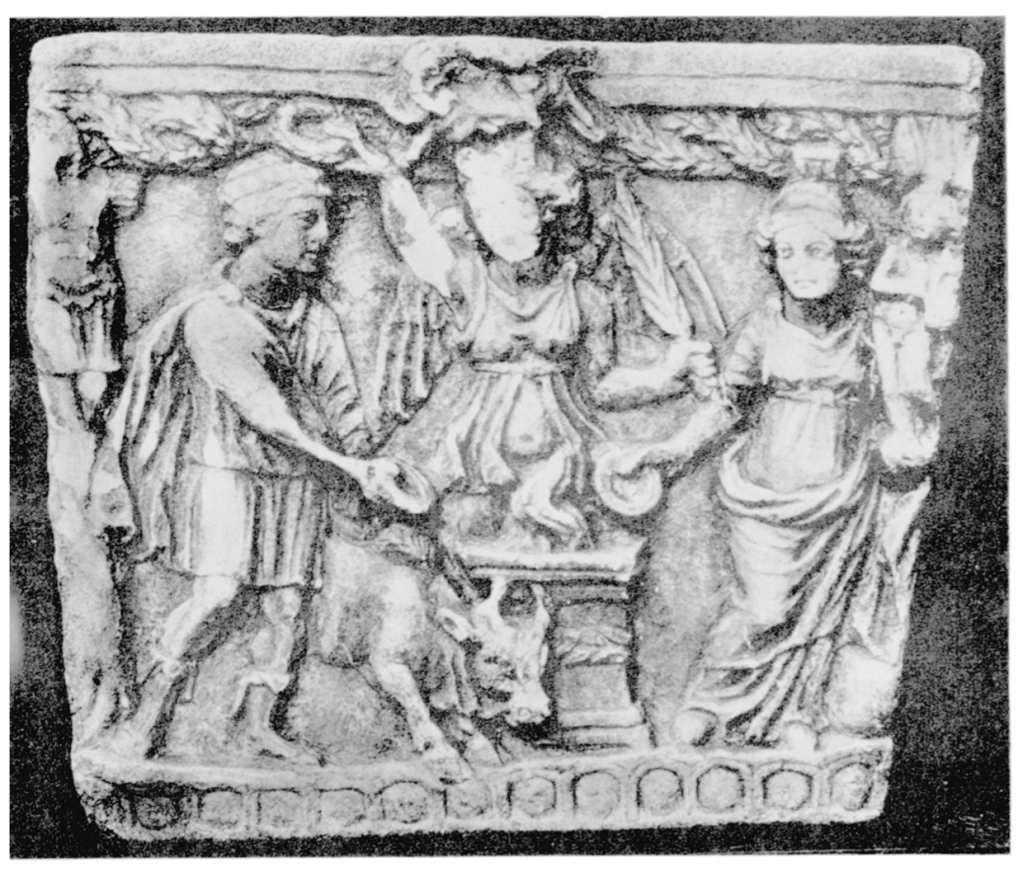
Source: Seyrig, “Scène historique sur un chapiteau du Musée de Beyrouth,” 1940.
Following his decisive victory over Antigonus at the Battle of Ipsos in 301 BCE, Seleucus I Nicator arrived at Antigonia, located northwest of the future Antioch near the Amuq Plain. As reported in ancient sources, Seleucus sacrificed a bull to Zeus there.[99] According to the legend, the eagle snatched a portion of the offering and carried it to the foot of Mount Silpius.[100] This act was interpreted as a divine intention to establish a new city at this location. Regarding the relief’s imagery and this specific version of the foundation myth, Seyrig proposes that this bas-relief depicts a scene unfolding before the temple of Zeus Bottiaios on Mount Silpius, the chosen site for the new city of Antioch. Following this interpretation, the crowned male figure on the left could represent Seleucus Nicator himself. Behind him, the relief might perhaps depict a trophy commemorating the victory at Ipsus, with the figure of victory crowning Seleucus for his triumph. The inclusion of Apollo, identified by the lyre he holds and laurels he is leaning, also strengthens the association with the Seleucid lineage, as the dynasty claimed descent from Apollo as well as Zeus and Heracles. Seyrig convincingly argues that the opposite figure to Seleucus represents the Tyche of Antioch given the presence of Apollo in her hand.[101]
Seyrig nevertheless points out several flaws in this interpretation.[102] First of all, the Tyche depicted on the relief does not resemble the well-known Tyche statue created by Eutychides, which served as the inspiration for Tycherepresentations in Antioch for centuries. Similar to this, the Apollo statuette that Tyche is holding differs significantly from Bryaxis’ well-known representation of Apollo dressed in a long robe for the Temple of Apollo at Daphne. Moreover, the motif of a flying eagle holding an ox’s head in its claws is foreign to Syrian iconography. In Antiochene accounts of the city’s foundation, the eagle typically carries either thigh meat.[103] Despite these differences, however, Seyrigmaintains that the most reasonable interpretation of the scene is that it portrays Seleucus’ sacrificial ceremony during Antioch’s foundation. He suggests that the relief represents a reinterpretation, with minor alterations, of this local tradition.[104]
Therefore, the bas-relief, examined by Seyrig and ostensibly depicting the city’s foundation[105] bears a remarkable resemblance to Libanius’ narrative, but only differing in that in Libanius’ account, the eagle steals the thigh-meat of the sacrificed animal. The focus, yet, in this study is not the minor variations in these local traditions. This thesis rather explores the way in which Libanius integrates a narrative about the origins of Antioch, combining the elements of history and mythology, into his larger narrative that bolsters Antioch’s Hellenistic heritage and its prominent position in this world. In this regard two further points are significant.
Firstly, as has been demonstrated, Libanius, in striking contrast to all extant written sources, claimed that Alexander the Great was the founder of Antioch. Libanius frequently employs this argument in his writings to bolster Antioch’s reputation as the city founded by the son of Zeus, regardless of his personal belief in the divine descent of Alexander.[106] Similar to this line of reasoning, Libanius meticulously constructs a genealogy that connects Antioch to the Greek gods. Beginning with Orestes, whose ancestry can also be traced back to Zeus according to classical mythology (he was the son of Agamemnon, son of Atreus),[107] Libanius’ narrative continues with Io and with Triptolemus and Argives, who wandered around to find her. Following them, this sequence proceeds with the arrival of Casus and the Cretans. In addition, the incorporation of Cypriots, who were brought by a Cypriot princess, and the Heraclidae, along with the Eleans,[108] leads to the final link, Alexander, who represents the culmination of this fine stock of Greek origin. Nevertheless, Libanius’ account does not conclude at that juncture. In order to fully establish this intricately crafted fictional genealogy, he would add the Athenians and Macedonians as the last additions, reinforcing the link between Antioch and its acclaimed Greek ancestry and positioning them as the final additions to this grand narrative on the city’s origins and fine Greek origins.
Following the most recent link, Alexander the Great, Libanius, would introduce Seleucus Nicator as the following essential figure who was destined to complete this exalted chain and bring Athenians and Macedonians to Antioch. Alexander had laid the foundations for Antioch, which was to become the pinnacle of Hellenistic civilization, and pointed out the location where the future city would rise (see above). However, Alexander’s death (according to Libanius, his ascension to his father Zeus) prevented him from realizing his plans for the city. One of his successors would eventually complete his plans for the city: Seleucus Nicator. He was so esteemed by Libanius in the highest regard that he was deemed the only heir worthy of succeeding Alexander.[109] The genealogy of Seleucus, traditionally also considered a descendant of Apollo,[110] further strengthened Libanius’ claim that Seleucus was Alexander’s rightful successor. By associating Seleucus’ divine lineage with his position as legitimate heir to Alexander, Libanius in a way elevated Antioch’s preeminence, proclaiming that Antioch was not only established by great Hellenistic emperors but also inherently associated with the gods.
This diligently constructed narrative, which incorporates Greek mythology, quasi-historical stories, and Libanius’ re-interpretations, is intended to reify Libanius’ conceptualization of Antioch as a city deeply rooted in Hellenic tradition. It illustrated Antioch as a place where the legacy of Alexander the Great and his plans for the city were ultimately fulfilled by his divinely chosen successor, Seleucus I Nicator. The emphasis placed on Seleucus I Nicator in Libanius’ account is hardly surprising but worth mentioning. Seleucus was the -actual- founder of both the city of Antioch and the Seleucid dynasty. In the Antiochikos, a eulogy dedicated to Antioch, Libanius dedicates a part to Seleucus himself, which serves, in a sense, a concise panegyric for him. Libanius provides an overview of Seleucus’ acts before becoming the ruler of the Seleucid empire and founding Antioch, highlighting his outstanding characteristics demonstrated via his actions (§§78-85). After this cursory demonstration, the final stage of this sequence of events is Seleucus’ decisive victory over the opponent Antigonus. Only at this juncture, according to Libanius, “it was the time for our city’s [Antioch] greatness come to pass, as previously it had happened with its first beginnings.”[111] This phrase emphasizes the crucial correlation between Seleucus’ victory and the rise of Antioch to the forefront, according to Libanius.
Although the previously mentioned similarities are undeniable, a careful revisit to the foundation account offered by Libanius in his Antiochikos offers valuable insights. Foundation account in this speech demonstrates how Libanius strategically employs this traditional tale to achieve two primary goals: firstly, to emphasize the role of divine intervention in the foundation of Antioch and, secondly, to fortify the city’s prominent role in the Greek world. Libanius describes the entire process as if everything were being orchestrated by divine providence, stating that “And everything occurred through the agency of God.”[112] Following his victory against Antigonus, Seleucus enters the city of Antigonia,[113]which his rival had established earlier. While performing a sacrificial ritual there, Zeus summons “his companion and ally,” the eagle, to the altar. The eagle plunges into the sacrificial fire and catches the victim’s thigh meat. While all those present were mesmerized by what was happening, Seleucus sends his son on horseback to follow the eagle to see what it would do with the meat. The eagle’s journey leads them to Emathia, where it drops the meat in front of the altar of the temple of Zeus Bottiaios. According to Libanius, Alexander himself had laid the foundations for this temple. This act by the eagle was an obvious sign of Zeus’ will, even for those unversed in prophecies: the new city is to be built on that very spot.[114] Thus, Libanius considers not only Alexander and Seleucus but also Zeus himself as one of the founders of Antioch. Therefore, Libanius identifies three founders for Antioch: a god (Zeus), a hero (Alexander the Great), and a man (Seleucus Nicator), thereby aligning his account of the city’s foundation with the prescriptions established by Pseudo-Menander:[115] “Thus the impetus which Alexander had given to the foundation, and the beginnings he had made, reached completion, and the king of heaven [Zeus] by means of omen became our founder.”[116]
According to Libanius, Seleucus spared no expense in building the city. He gathered skilled artisans and laborers, along with gleaming marble, to construct the city. Seleucus set the boundaries of the city by placing elephants where he wanted towers to be and used the wheat carried by ships anchored in the river Orontes to determine the length and width of the city’s colonnades and streets.[117] The following narrative reveals a swift and oversimplified account of Antioch’s population growth. Libanius says that inhabitants of Ione -Argives, Cypriots, and Heraclidae- come down from the surrounding mountain. In addition, some of Seleucus’ soldiers chose to settle in the new city. Most importantly, Seleucus relocates the residents of Antigonia, the city he demolished, to Antioch. This group, he notes, includes Athenians.[118]Thus, the ancient and glorious origins of Antioch, with its diverse Greek lineages, are fully established.
Libanius further relates that the Antigonians, initially fearing Seleucus’ wrath, were relieved when no retribution was inflicted upon them. They afterward erected in his honor a bronze statue showing him with bull horns. While Libanius interprets this detail as a reference to Io, a figure associated with the very beginnings of Antioch, reminding his Antiochene audience of this “token,”[119] a more likely explanation lies in Appian’s account in Syriaca. According to a story there, Seleucus killed an escaped bull with his bare hands while attending a feast hosted by Alexander.[120]Libanius’ reinterpretation of this specific detail, however, serves his overall agenda, further emphasizing the connection between Antioch and its mythical past. Finally, Seleucus gives the name of his father, Antiochus, to the city.[121]
Libanius continues narrating Seleucus’ deeds relating to Antioch, this time referring to the occurrences at Daphne. He once again demonstrates his adept inclusion of local myths into his quasi-historical account. A famous Greek (and Roman) myth relates the tale of Apollo’s infatuation with the nymph Daphne. In order to flee Apollo’s pursuit, Daphne invokes her father, the river god Ledon, just before Apollo’s imminent kiss; as a result, she is metamorphosed into a laurel tree.[122] Libanius skillfully inserts a local variant of this widespread myth into his narrative. This integration not only provides an etiological explanation for Daphne’s origins but is also intended to emphasize Daphne’s significance within the broader Hellenic world. Libanius believes that Seleucus discovered that this legend was “true” while hunting near Daphne.[123] During the chase of his hunt with his horse and hounds, suddenly, his horse rears and paws the ground. Seleucus stops at the very spot where Daphne’s transformation is said to have occurred. At that very location, beneath the earth, he recognizes a golden arrowhead inscribed with the name of Apollo Phoebus. Libanius reads this as a clear message to Seleucus—a divine instruction to venerate this place and revere it as a temple dedicated to Apollo. Furthermore, Libanius recounts that upon taking up the arrowhead, Seleucus encounters a hissing serpent. This instance, for Libanius, is a further manifestation of Daphne’s association with Apollo and that this very place is his haunt. Immediately, Seleucus demarcates the boundaries of the sanctuary, encompassing its trees and temples.[124]
Through skillful manipulation of this myth, Libanius efficiently boosts the stature of Antioch and Daphne and consequently underscores their vital importance in the Hellenistic period. Furthermore, it stresses the distinctive bond between Apollo and the Seleucid dynasty. Through this version of the myth, Libanius constructs an intriguing analogy, picturing Seleucus as arriving at a designated sacred land. The remaining part of Libanius’ narrative reveals further fabrication and distortion of quasi-historical records to back up this assertion. Libanius narrates that, during a period of distress, Seleucus asked for guidance from the oracle at Miletus. The oracle, he asserts, prophesied Seleucus an empire and told him to dedicate Daphne upon assuming the reins of power.[125] However, other historical accounts present a different story. While still serving under Alexander, Seleucus did consult the oracle of Apollo of Didyma in Miletus, asking for advice on whether to go back to Macedonia. The oracle, in turn, advised him not to return to Europe, saying that Asia would be better for him. There is no hint of Daphne in this account, nor is there any other reference to this location in other historical records on Seleucus’ interactions with oracles.[126] While it is questionable whether Libanius was familiar with the works of Appian or other historians who related these occurrences, it is still reasonable to suppose that Libanius knew at least a different version of this story. He then strategically inserted this version, either in its original form or with his own interpretation, to comply with his narrative.
A considerable part of the Antiochikos is understandably committed to Seleucus and his successors. Seleucus possesses the privilege of being the city’s founder, and his successors reigned during a period during which Antioch acquired its distinctive Hellenistic character. Nonetheless, a critical assessment of Libanius’ description of the Seleucid dynasty reveals a history undoubtedly loaded with exaggeration, manipulation, and omission. As discussed above, Libanius devotes very little attention to Antioch’s Roman period. This disparity in focus allocated to two periods is not surprising, but it is nonetheless crucial to understanding Libanius’ agenda. Libanius’ main argument is that, even under Roman rule, Antioch remained the most significant representative of the Hellenic tradition, which had been tightly rooted in its mythological and Greco-Hellenistic past. At this point, it is unnecessary to examine in detail his treatment of every Seleucid emperor. Nonetheless, it is essential to acknowledge Libanius’ conspicuous neglect of the turmoil and defeats of the Seleucid dynasty in later periods. In his idealized narrative, the Seleucid kings tirelessly nurtured Antioch and promoted the propagation of Hellenistic civilization—in stark contrast to established historical facts. Just as Libanius hails Seleucus as the legitimate successor of Alexander, son of Zeus, so he also exalts the successors of Seleucus. In his eyes, they had inherited a legacy and were worthy to rule because of that legacy alone:
So in the midst of such achievements, he [Seleucus I] lived and died, and his inheritance passed to men not inferior to him. All his descendants were fine men, son of fine fathers, the sons emulated their fathers in ordinary matters and in love which they had for our city.[127]
Libanius emphasizes Seleucus’ remarkable efforts in city-building. He contrasts him with other rulers, saying: “While other kings take pride in the destruction of existing towns, his glory has been that he made cities rise which had not before existed.”[128] He compares Seleucus’ city-building with that of the Athenians and Milesians, who were famous for their colonies in antiquity, and claims that they even could not compete with Seleucus. However, according to Libanius, despite the fact that Seleucus established numerous cities, Antioch remained his most essential city. He even claims that Seleucus esteemed Antioch so much so that he built all other cities to serve it and could think of no better place for his capital:
Yet though he founded many cities after ours,[129] it cannot be said that he preferred any other to it. Here he established his capital himself, and gave it its due in other respects, as though he built the others to be handmaids to our city, and never saw a more fitting place for his palace.[130]
One further significant point about Libanius’ foundation account regarding the paramount role he bestows upon Antioch is his conspicuous silence on Seleucia Pieria, the city which Seleucus established before Antioch, on the point where the river Orontes flows into the Mediterranean.[131] According to Downey, Seleucia Pieria might have been built as the new capital of the Seleucid dynasty. He supports this claim, saying that Seleucus was buried there and that he gave his name to the new city.[132] Downey further claims that Antioch became the Seleucid capital in the reign of Antiochus I (280/1-261 BCE).[133] These claims challenge Libanius’ recounting of events and are conducive to reconsidering the relative importance of Antioch to Seleucus Nicator. The sacrificial ceremony performed by Seleucus before the founding of this Seleucia bears a remarkable resemblance to the myth of Antioch’s foundation -like those of the other two cities of the Tetrapolis, i.e. Laodiceia and Apamea.[134] It is highly improbable that Libanius did not know Seleucia’s founding myth and its historical significance to the Seleucid dynasty.[135] However, to align with his own agenda, Libanius deliberately omits this narrative and downplays the importance of Seleucia during the first years of Seleucid rule.[136] In his narrative, Antioch’s role as a capital city from its very foundation is without question. Only such a statement could align with the proposed prominence of Antioch within the Hellenistic world and with Libanius’ civic pride.
[1] Cameron, “Remaking the Past,” 2.
[2] The term “myth” is difficult to define. When we talk about myth, we are not referring to a simple fable or a made-up story as commonly understood today. While it may be hard to provide a universally satisfying definition of how past societies understood myth, Mircea Eliade’s definition can serve as a valuable guide for this study. According to Eliade, although he does not find this definition entirely satisfactory, myth is a narrative that tells a story from primordial times and sacred history, mainly about the origins of things, “the fabled time of the ‘beginnings.’” Myths explain how reality came into being through supernatural beings. This reality may include the entire reality itself or just a part of it, such as an institution or human behavior. Eliade also notes that because myths concern reality and engage with it, the history they recount is perceived as a real history. In the context of this study, and as will be seen in Libanius’ etiological and foundation accounts, this definition of myth is appropriate. Eliade, Myth and Reality, 5-7.
[3] Wiemer, “Vergangenheit und Gegenwart im Antiochikos des Libanios.”
[4] But which Christian God? Certainly, for Christians, there was only one God, but among the sects we now label as Christian, there was no consensus on the definition of God. The fourth century was a period of intense debate among Christians regarding the definition of this God, more precisely, the relationship between God the Son and God the Father, and the search for a logical formulation of this relationship. When discussing the Christian God in the context of Chrysostom, we refer to the God defined by the creed he supported, namely those established at the Council of Nicaea in 325 and reaffirmed at the Council of Constantinople in 381.
[5] Libanius, Oration, 11.11; Saliou, “Libanius’ Antiochicus, Mirror of a City? Antioch in 356, Praise and Reality,” 48; Saliou, “Rhétorique et réalités : l’eau dans l’Éloge d’Antioche (Libanios, Or. XI),” 11.
[6] Stenger, “Libanius and the Game of “Hellenism,” 271.
[7] This situation should be viewed in the context of the prevailing principles of the epideictic oratory of that time. Libanius’s portrayal of Antioch in the Antiochikos is similar to the city eulogies commonly seen in the fourth century (and before) and it closely conforms to the norms of encomia set by Pseudo-Menander. For Pseudo-Menander and two works attributed to him, see: Russell and Wilson, Menander Rhetor – A Commentary. Laurent Pernot, La rhétorique de l’éloge dans le monde gréco-romain, vol. 1, 187.
[8] For other studies on the foundation accounts of cities in the Roman/Byzantine world: For a detailed examination of the Patria of Constantinople, see G. Dagron, Constantinople imaginaire: études sur le recueil des Patria; particularly useful is the first chapter, “Éloges et récits des origines,” pages 1-19, which discusses foundation accounts. For patria as a genre, see Moffatt, “A Record of Public Buildings and Monuments,” 96-99. For an English translation of the Patria of Constantinople according to Hesychius Illustrius (fl. 6th century CE), see Albrecht Berger, trans., Accounts of Medieval Constantinople: The Patria. For Adrianople, refer to Buket Kitapçı-Bayrı, “Two Tales of a City: Adrianople/Edirne.
[9] For the story of Io and Zeus in the foundation account of Constantinople, see: Hescychios Illoustrios, Patria, 4, in Accounts of Medieval Constantinople: The Patria, trans. Albrecht Berger, 4-5.
[10] Libanius, Oration 11.44-7. Libanius, adhering to rhetorical norms, is continuing the ancient tradition that extends back to Strabo (16.2.5); cf. Menander Rhetor, Treatise 1, 2. 353-354.
[11] Libanius, Oration 15.79 (Förster 2, 152): “ἱκετεύει σε πόλις Ἰνάχου γένος ἔχουσα κατὰ ζήτησιν τῆς Ἰοῦς πλανηθέν (…).”
[12] cf. Strabo, 16.2.5; also cf. Pseudo-Menander, Treatise 1, 2.357 on the “heroic causes” of foundation of cities.
[13] cf. Pseudo-Menander, Treatise 1. 3. 362: “‘Best gods’ applies to Zeus at Olympia and Nemea.” [τοὺς ἀρίστους δέ, ὥσπερ Ὀλυμπίαν τὸν Δία καὶ Νεμέαν (…)]
[14] As time went on, according to Libanius, they dedicated the temple to Zeus Epikarpios (“bringer of fruits,” LSJ): Oration, 11.51. As will be shown in the fifth chapter Malalas also relates the same story with minor variations: Malalas, 2.7-8.
[15] Aside from the allusions found in Libanius, Malalas, and Strabo, we know little about these individuals. Excavations at al-Mina (near present-day Samandağ, Turkey) can also be included in this context, see T. Vorderstrasse, Al-Mina: A Port of Antioch from Late Antiquity to the End of the Ottomans, esp. 10-31; Vorderstrasse, “A Port of Antioch : Late Antique Al-Mina.” However, it is evident that settlements existed in the Amik Plain from the third millennium BCE, such as Alalakh (Tell Atchana): L. Woolley, A Forgotten Kingdom: Being a Record of the Results Obtained from the Excavation of Two Mounds Atchana and Al Mina, in the Turkish Hatay; more recent contributions: Kutlu Aslıhan Yener, ed., The Amuq Valley Regional Projects: Surveys in the Plain of Antioch and Orontes Delta, Turkey, 1995-2002. Volume 1; M. Akar and H. Maloigne, eds., Unutulmuş krallık: antik Alalah’ta arkeoloji ve fotoğraf = The forgotten kingdom: archaeology and photography at ancient Alalakh. Also see Downey, A History of Antioch, 46-52; A. De Giorgi and A. Eger, Antioch: A History, 21-23.
[16] Libanius, Oration 11.47-51.
[17] Libanius follows what had been proposed by Pseudo-Menander, cf. Treatise I, 2. 353 and 357, I. 2, 353: “If a god, the encomium is the grandest (…).” In addition to this, why Zeus? We may want to contemplate this question through the perspective presented by Dumitru. Dumitru suggests that Zeus was the deity most closely linked with the foundation of Hellenistic cities in line with Greek tradition. Furthermore, the integration of the veneration of local gods into the worship of Zeus in newly colonized areas was the easiest. Adrian George Dumitru, “‘It Was an Act of God’: On the Religious Dimension of the City Foundation in the Seleucid Kingdom, IIIrd Century B.C.,” 207.
[18] Libanius, Oration 11.52-53. With this story hence Antioch is linked to the cult of Zeus Casius of the Mount Casius. This cult and Mount Casius would play a significant role in reign of Julian, cf. Libanius, Oration 18.172; Malalas, 13.19.
[19] According to Malalas, her name was Amyce, and this name was given to the plain near Antioch: Malalas, 8.15.
[20] Libanius, Oration 11.54.
[21] cf. Pseudo-Menander, Treatise 1, 2. 353-354. Argives, people of Argos, in Southern Greece; Cretans from the island of Crete; Eleans, people of Elis, in the western part of Peloponnese peninsula; Heraclidae, i.e., descendants of Heracles. For more detail, see: Catherine Saliou, “Les fondations d’Antioche dans l’Antiochikos (Oratio XI) de Libanios,” 357–88, esp. pp. 359-366.
[22] Libanius, Oration 11.56. Heracles was depicted on mosaics at Daphne: Levi, Antioch Mosaic Pavements, I, 21ff.; II, Tables IV b, XXX b.
[23] Libanius, Oration, 11.57 (Förster 1, Fasc.2, 454-455): σκοπείτω δή τις τὴν εὐγένειαν καὶ ὡς ὅτιπερ κράτιστον τῶν ἑκασταχοῦ, τοῦτο ἐνταυθοῖ συνερρύηκεν, ὥσπερ εἴς τι χωρίον ἐξῃρημένον ὑπὸ τῶν κρειττόνων εἰς ὑποδοχὴν ἀνδρῶν ἀξίων θαυμάσαι, καὶ μόνοις ἡμῖν αἱ ῥίζαι τὰ παρ’ ἑκάστοις σεμνὰ συνήγαγον εἰς ταυτό, τὴν Ἀργείων παλαιότητα, τὴν Κρητικὴν εὐνομίαν, γένος ἐκ Κύπρου βασίλειον, τὴν Ἡρακλέους ἀπορροήν.
[24] Libanius, Oration, 11.92, 163; Oration, 15.79. Also cf. empress Eudocia’s visit to Antioch in Evagrius Scholasticus, Historia ecclesiastica,1.20.
[25] Libanius, Oration, 11.68 (Förster 1, Fasc.2, 458): ἔχοντες τοίνυν τὴν Ἰώνην οἱ τότε, (…) καὶ τελοῦντες τὰ εἰκότα τοῖς θεοῖς μετ’ εὐδαιμονίας ἁπάσης ᾤκουν ἐν μέσῃ τῇ βαρβάρῳ πόλιν Ἑλλάδα παρεχόμενοι καὶ τηρήσαντες τὸ ἦθος καθαρὸν (…). cf. Himerius, Oration, 39.5, also writes of Thessalonica as a beacon of Greek culture amidst the barbarian world: “To the north the Paeonians press upon it. The next neighbors of the city are the Illyrians, who in turn pass that role on to the Moesians. Thrace borders so closely on this city of yours that it touches its suburbs. Your city, in isolation, maintains the Greek language like a golden center point and keeps it free of contamination by any neighboring tongue.” (trans. Penella, 51) (ἄνωθεν μὲν Παιόνων ἐπικαθημένων τῇ πόλει, ἐχομένως δὲ Ἰλλυριῶν καὶ Μυσῶν παραδιδόντων τὸ γείτοσιν εἶναι τῆς πόλεως, Θρᾴκης ἄχρι καὶ προαστείων ἐπιβεβηκυίας τοῖς ὅροις, μόνη καθάπερ τινὰ χρυσοῦν ὀμφαλὸν τὴν Ἑλλάδα γλῶσσαν ἀνέχουσα, καθαρὰν ταύτην φυλάττει τῆς ἐπιμιξίας τῆς γείτονος.) See: Wiemer, “Vergangenheit und Gegenwart im Antiochikos des Libanios,” 451.
[26] Norman, Antioch as a Centre of Hellenic Culture, 3; Downey, Antioch, 653.
[27] Libanius, Oration, 11. 64 (Förster 1, Fasc.2, 457): “παρὰ θεοῖς ἄνωθεν ἐράσμιος ὁ χῶρος.”
[28] Borrowing from Sandwell, Religious Identity in Late Antiquity, Greeks, Jews, and Christians in Antioch, 11.
[29] Libanius, Oration, 11. 88. Almost two decades later, this time, John Chrysostom was expressing his faith in Christian God who “corrected and restored” Antioch with his wise plan: Chrysostom, Ad populum Antiochenum, 15.3. Wiemer thinks that the historical account of Antiochikos was not pronounced during the occasion of its first delivery, but later added to the text: Wiemer, “Vergangenheit und Gegenwart im Antiochikos des Libanios.”
[30] cf. Malalas, 8.31, recounts the event as follows: A general named “Byblos” (Calpurnius Bibulus, proconsul of Syria in 51/0 BC) requested, as a favor from the Antiochians, the statues of Athene and Zeus Keraunios (not Kassius), both “tremendous,” which had been erected in the city by Seleucus. He sent these statues to the Capitol in Rome. During his time, the statues were still standing, with the following inscription: “The people of Antioch the Great honoured the Romans by presenting statues in gratitude.”
[31] Libanius, Oration, 11.115-116 (Förster 1, Fasc.2, 473-474): “καὶ καταγώγιον ἦν τῶν κρειττόνων ἡ πόλις, ὥστε καὶ πρὸς τὸν Ὄλυμπον ὑπάρχειν ἡμῖν ἐρίζειν, εἰ βουλοίμεθα. ἡ μὲν γὰρ αὐτόθι τῶν θεῶν διατριβὴ ποιητῶν ἐστι φήμη, τὰ δ’ αὖ παρ’ ἡμῖν ὀφθαλμοὺς ἔπεισε. (…) καὶ συμπροῆλθε τὰ ἔργα τῷ χρόνῳ, ἐπεὶ καὶ τῆς Ῥωμαίων ἰσχύος ἤδη πάντα ἐπισχούσης τοῦτό γε οὐ μετέπεσε τῇ πόλει, ἀλλ’ ἔπαθον μέν τι πρὸς τὸν Κάσσιον ἐκεῖνοι Δία τοιοῦτον, (…) ὁ δὲ κεραυνοὺς ἐφ’ ἅπαντα ἀφιεὶς ἐνέκειτο τὴν ἐπάνοδον αὑτῷ παρασκευάζων καὶ ἀνέστρεφεν.”
[32] Libanius, Oration, 11.20 (Förster 1, Fasc.2, 443): “ἄπεστι δὲ οὐδὲν ὃ παρεῖναι βέλτιον, ἀλλ’ ἄν τε τὸν Διόνυσον εἴπῃς, πολὺς παρ’ ἡμῖν βακχεύει, ἄν τε τὴν Ἀθηνᾶν, τῷ φυτῷ αὐτῆς ἡ γῆ κομᾷ·”
[33] Libanius, Oration, 11.21. The shield of Achilles made by Hephaestus: Homer, Iliad 18.478 ff.
[34] Libanius, Oration, 11.237 (Förster 1, Fasc. 2, 520-21): “θεοὶ δὲ εἴπερ ὄντως οὐρανὸν ἀφέντες εἰς γῆν ἔρχονται, τῇδέ μοι δοκοῦσι συνεῖναί τεκαὶ συνεδρεύεινὡς οὐκ ἂν ἐν καλλίονι διατρίψαντες.”
[35] Chrysostom, Ad populum Antiochenum, 15.3
[36] cf. Pseudo-Menander, Treatise 1. 3. 362-363.
[37] Hence he employs nearly all twelve Olympians, giving roles to them in Antioch’s foundation and exalted status, or just a part in its mythological history, except for Ares and Hestia (sometimes replaced by Dionysus): in Oration 11; Zeus: 41,77, 86, 88, 236, 241, 268; Hera: 41; Poseidon: 66, 241; Demeter: 21, 125; Athena: 20, 66, 228, 235; Apollo: 65, 94, 96, 111, 169, 204, 235, 236, 241, 228 (as Phytius), 96 (as Phoebus); Artemis: 59, 65, 109, 116; Aphrodite: 234, 267, 271; Hephaestus: 21, 241, 267; Hermes: 183; and Dionysus: 20.
[38] Wiemer, “Vergangenheit und Gegenwart im Antiochikos des Libanios,” 464.
[39] Chrysostom, Ad populum Antiochenum, 17.10 (PG 49.176): “Βούλει μαθεῖν σου τῆς πόλεως τὸ ἀξίωμα; βούλει τὰ πάτρια αὐτῆς εἰδέναι; Ἐγὼ ταῦτα μετὰ ἀκριβείας ἐρῶ (…)”.
[40] Chrysostom, Ad populum Antiochenum, 17.10 (PG 49.176):[Ἐγένετο πρῶτον ἐν Ἀντιοχείᾳ τοὺς μαθητὰς χρηματίσαι Χριστιανούς.] Τοῦτο δὲ οὐδεμία τῶν κατὰ τὴν οἰκουμένην ἔχει πόλεων, οὐδ’ αὐτὴ ἡ Ῥωμύλου πόλις. See Himerius, Oration 62.5, which he wrote of Constantinople, for Rome as a point of comparison: “You [Constantinople] alone have outdone the city of Romulus in the wonder you instill. you have combined such beauty with your size that the inhabitants of [Rome] have nothing to match with your beauty.” (Penella, trans., Man and the Word – The Orations of Himerius, 47) [σὺ καὶ τὴν Ῥωμύλου πόλιν μόνη παρῆλθες τῷ θαύματι, τοσοῦτον κάλλος τῷ μεγέθει μίξασα, ὡς καὶ τοὺς ἐκείνης οἰκήτορας οὐκ ἔχειν ὅ τι πρὸς τὸ κάλλος ἀντιφθέγξονται.] A. Colonna, Himerii declamationes et orationes cum deperditarum fragmentis, 62.39-42. Penella sees this reference and the Oration itself a step towards the notion of Constantinople as new Rome: Penella, Man and the Word – The Orations of Himerius, 47 n. 37.
[41] Acts 11.26: “So for a whole year Barnabas and Saul met with the church and taught great numbers of people. The disciples were called Christians first at Antioch.” (trans. New International Version). Chrysostom, In epistulam i ad Corinthios, 21.9; Chrysostom, Ad populum Antiochenum, 14.16, 3.3-4; in 3.4 (PG 49, 49.26-8): “(…) this city was the first of cities that adorned itself by assuming the Christian appellation, as a sort of admirable diadem.” [(…) αὕτη πρώτη, ὥσπερ στέφανόν τινα θαυμαστὸν, τὴν τῶν Χριστιανῶν ἀνεδήσατο προσηγορίαν.]
[42] The reasons behind Acts 11.26, or to put it another way, the question of why the disciples/believers called Christians first at Antioch, has been studied widely. For a summary, one should refer to Justin Taylor’s “Why Were the Disciples First Called ‘Christians’ at Antioch? (Acts 11,26).” Taylor states that the Roman authorities in Antioch were the first to refer to the disciples as Χριστιανοί (Christians). Initially, it was used as a derogatory term, coined after the unrest in Antioch during the rule of Gaius in 39-40 CE, for which the Christians were held responsible. Is it possible that John Chrysostom referred to this when he was addressing Emperor Julian in De sancto hieromartyre Babyla (PG 530.16-20; NPNF 1, 9, 141)?: Καίτοι εἰ τὸ ὄνομα τῶν Χριστιανῶν μύσος εἶναι ἐνόμιζε, καὶ πολλῆς τὸ πρᾶγμα γέμειν αἰσχύνης, τίνος ἕνεκεν οὐκ ἐντεῦθεν ἡμᾶς, ἀλλ’ ὀνόματι ξένῳ καταισχύνειν ἐπεθύμει; “(..) and yet if he thought the names of Christians an abomination, and Christianity itself to be full of much shame, for what reason did he not desire to put us to shame by that means, but with a strange name?” Eurell, in “Becoming Christian: On the Identification of Christ-Believers as Χριστιανοί,” on the other hand, discusses how the term, first an ideal, a title of honor for Christ-believers, evolved into a term of self-designation by Christian groups.
[43] Chrysostom, Ad populum Antiochenum, 14.16 (PG 49.153): (..) οὕτω δὴ καὶ τὸ κατόρθωμα τοῦτο τὴν ῥίζαν καὶ τὴν ἀφορμὴν ἐντεῦθεν λαβὸν, πάντας τοὺς τὴν γῆν οἰκοῦντας ἀνθρώπους μαθητὰς ὑμετέρους ἐργάσεται (…).
[44] Sandwell, “Christian Self-Definition in the Fourth-Century AD: John Chrysostom on Christianity, Imperial Rule, and the City,” 42.
[45] Chrysostom, Ad populum Antiochenum, 14.16 (NPNF 1,9, 438; PG 49.153): Μᾶλλον δὲ, ἂν τοῦτο γένηται, οὐκ αὐτὴ στεφανωθήσεται μόνη, ἀλλὰ καὶ ἑτέρας εἰς τὸν αὐτὸν ἐνάξει ζῆλον· καὶ καθάπερ τὸ ὄνομα τῶν Χριστιανῶν ὥσπερ ἔκ τινος πηγῆς ἐντεῦθεν ἀρξάμενον πᾶσαν τὴν οἰκουμένην ἐπέκλυσεν, οὕτω δὴ καὶ τὸ κατόρθωμα τοῦτο τὴν ῥίζαν καὶ τὴν ἀφορμὴν ἐντεῦθεν λαβὸν, πάντας τοὺς τὴν γῆν οἰκοῦντας ἀνθρώπους μαθητὰς ὑμετέρους ἐργάσεται, ὥστε διπλοῦν ὑμῖν καὶ τριπλοῦν γενέσθαι τὸν μισθὸν, καὶ ὑπὲρ τῶν οἰκείων κατορθωμάτων, καὶ ὑπὲρ τῆς τῶν ἄλλων διδασκαλίας. Τοῦτο διαδήματος ὑμῖν παντὸς ἔσται λαμπρότερον, τοῦτο μητρόπολιν ὑμῖν ποιήσει τὴν πόλιν, οὐκ ἐν τῇ γῇ, ἀλλὰ καὶ ἐπὶ τῶν οὐρανῶν·
[46] Chrysostom, De sancto hieromartyre Babyla, 1 (PG 50, 527).
[47] cf. Brown, “The Rise and Function of the Holy Man in Late Antiquity,” 80-101.
[48] Chrysostom, De sancto hieromartyre Babyla, 1 (PG 50, 528).
[49] Chrysostom, De sancto hieromartyre Babyla, 2 (PG 50. 531.17): ὁ μάντις, ὁ μέγας τῶν Ἑλλήνων θεός
[50] Chrysostom, De sancto hieromartyre Babyla, 2 (PG 50.531): Τί τούτων ἀνοσιώτερον γένοιτ’ ἂν τῶν ἐπιταγμάτων; Ξένους ὁ δαίμων τυμβωρυχίας εἰσάγει νόμους, καὶ καινοὺς ξενηλασίας ἐπινοεῖ τρόπους. Τίς ἤκουσε νεκροὺς ἐλαυνομένους ποτέ; τίς εἶδε σώματα ἄψυχα κελευόμενα μετανίστασθαι, καθάπερ οὗτος ἐπέταττε, τοὺς κοινοὺς τῆς φύσεως ἐκ βάθρων ἀνατρέπων νόμους;
[51] Chrysostom, De sancto hieromartyre Babyla, 3 (PG 50, 532-533): Καὶ γὰρ τότε, ἡνίκα ἀπὸ τῆς Δάφνης ἐπανῄει, πᾶσα μὲν ἡμῖν ἡ πόλις εἰς τὴν ὁδὸν ἐξεχύθη, καὶ κεναὶ μὲν αἱ ἀγοραὶ ἀνδρῶν, κεναὶ δὲ γυναικῶν ἦσαν αἱ οἰκίαι, ἔρημοι δὲ παρθένων οἱ θάλαμοι. Οὕτω καὶ ἡλικία πᾶσα, καὶ φύσις ἑκατέρα τῆς πόλεως ἐξεπήδησαν, ὥσπερ πατέρα ἀποληψόμενοι χρόνιον, ἐκ μακρᾶς ἐπανιόντα τῆς ἀποδημίας, (…).
[52] As he did in some of his other apologetic writings. However, it would be inaccurate to claim that Chrysostom directed his apologetic works solely against pagans. We can name, for instance, two other apologetic works of him directed against pagans: Discourse on Blessed Babylas and Against the Greeks and Demonstration Against the Pagans that Christ is God. Against Anomoean Christians he wrote five homilies titled under De incomprehensibili dei natura (Contra Anomoeos) (PG 48.701-48; and SC 28 bis. 92-322). We encounter his arguments aimed at refuting the claims of the Manicheans: e.g., In Genesim 1.1 (PG 54.581); In Genesim 7.4 (PG 54.613); In diem natalem (PG 49.359).
[53] cf. C. Davoine, “Des ruines pour la postérité ? le temple d’Apollon à Daphné après l’incendie de 362.”
[54] Chrysostom, De sancto hieromartyre Babyla, 3 (NPNF 1, 9, 143; PG 50.522): “Καὶ γὰρ ἑστήκασιν οἱ τοῖχοι νῦν ἀντὶ τροπαίων, σάλπιγγος λαμπροτέραν ἀφιέντες φωνὴν, τοῖς ἐν τῇ Δάφνῃ, τοῖς ἐν τῇ πόλει, τοῖς πόῤῥωθεν ἀφικνουμένοις, τοῖς συνοῦσι, τοῖς αὖθις ἐσομένοις ἀνθρώποις ἅπαντα διηγοῦνται διὰ τῆς ὄψεως, τὴν πάλην, τὴν συμπλοκὴν, τὴν νίκην τοῦ μάρτυρος.”
[55] The dissemination of Greek myths in the eastern Hellenistic domains was a common phenomenon. Greek myths were intricately intertwined with local traditions: A. Bousdroukis, “The Tetrapolis and Other City Foundations,” in A Companion to the Hellenistic and Roman Near East, ed. Kaizer, 201; L. Capdetrey, Le pouvoir séleucide, 67-69; P.-L. Gatier, “Géographie mythologique de l’Oronte dans l’antiquité,” 249–69. Libanius seems to follow the same pattern, or more accurately, he uses localized Greek myths in his conceptualization of the city.
[56] Libanius, Oration, 11. 235-41. For the mosaic of the Judgement of Paris, from Antioch from the so-called Atrium House, now in Louvre Museum see Levi, Antioch Mosaic Pavements, 1, 16-21; Plates: II. I. b; for all the panels from the Atrium House: Pls. I, II a, CXLII a, CXLV-CXLVIII.
[57] Libanius, Oration, 11.241 (Förster 1, Fasc.2, 522): “πείθομαι δὲ κἀκεῖνο τὰς τρεῖς θεάς, ὅτε περὶ κάλλους ἤριζον, ἐνταυθοῖ λουσαμένας ἥκειν ἐπὶ τὴν κρίσιν μᾶλλον ἢ οὗ λέγονται.”
[58] For the role of Orestes in the foundation account of Adrianople, see: Buket Kitapçı-Bayrı, “Two Tales of a City. Adrianople/Edirne,” 535-539; for other places, where Orestes and Iphigenia established the cult of Taurian goddess, according to ancient sources, see: P. G. Bilde, “Wandering Images: From Taurian (and Chersonesean) Parthenos to (Artemis) Tauropolos and (Artemis) Persike,” 166-167.
[59] After discussing Greek gods, Libanius this time draws a connection between Greek heroes and Antioch. This suggests that he continues to follow the norms transmitted by Pseudo-Menander, cf. Pseudo-Menander, Treatise 1, 2. 357.
[60] Homer, Odyssey, 1.35 ff.
[61] Homer, Odyssey, 3.300-310; 3.313-316.
[62] The story of Orestes is narrated in Aeschylus’ trilogy, Oresteia, including Agamemnon, Choephoroi, and Eumenides.
[63] Orestes’ legend was treated by Euripides at length, in his Electra, Iphigeneia in Tauris, and Orestes; touched briefly in his Andromache.
[64] cf. Malalas on Orestes in his Chronographia, 5.60-68.
[65] The phrase, “the event gave the name to the place,” is referring to Mount Amanos (Ἀμανός); even though Libanius does not give the name, Malalas does (5.67). cf. Saliou, “Statues d’Antioche de Syrie dans la Chronique de Malalas,” 75. Libanius, Oration, 11.175 (Förster 1, Fasc. 2, 495-496): “ἐπεὶ καὶ τὸν παῖδα Ἀγαμέμνονος μετὰ τὸν φόνον τῆς μητρὸς διὰ τῆς ἄλλης ἁπάσης λυττῶντα κατὰ κράτος ὑπὸ τῶν θεῶν διωκόμενον, αἳ τῇ μανίᾳ τὸν νεανίσκον ἐκόλαζον, ἥδε ἡ γῆ πρὸς τὸ σωφρονεῖν ἐπανήγαγεν. ὡς γὰρ ἐπέβη τοὺς ὅρους, ἐλέλυτο ἡ νόσος, καὶ τὸ συμβὰν ὄνομα τῷ τόπῳ γίνεται.”
[66] Libanius, Declamationes, 6.5-11, 17-20. For a comprehensive study of ten of Libanius’ declamations and their translations see: Penella, Libanius: Ten Mythological and Historical Declamations: Introduction, Translation, and Notes.
[67] cf. Arrian, Anabasis Alexandri, 2.13.7, 2.14.1 ; Quintus Curtius Rufus, Historiae Alexandri Magni, 3.6-11; Plutarch, Alexander, 19.1 ff., 20.3 f.; Diodorus Siculus, Bibliotheca Historica, 17.31-35; Justinus, Epitoma Historiarum Philippicarum Pompei Trogi, 11.8 f.
[68] Downey, A History of Antioch in Syria, 54-55; cf. Malalas, 10.238; cf. Libanius, Oration, 11. 72-77, 82, 250; Oration, 15.79.
[69] Anthologia Graeca, 9.699: Ἔνθεν Ἀλέξανδρος Μακεδὼν πίεν ἀγλαὸν ὕδωρ·/μητρὸς δ’ εἶπε γάλακτι πανείκελα ῥεύματα πηγῆς, / ᾗ καὶ Ὀλυμπιάδος πόρεν οὔνομα, σῆμα δὲ τοῦτο. Translation from: W. R. Paton, trans., The Greek Anthology, Vol. 3, LCL 84, 386-387.
[70] Libanius, Oration, 18.297, 20.22, 11.77, 55.13.
[71] According to Saliou, with this account of the Olympias spring, Libanius seeks to demonstrate the continuity between the city’s past and present, as well as its profound connection to its Hellenistic past: Saliou, “Rhétorique et réalités : L’eau dans l’Éloge d’Antioche (Libanios, Or. XI),” 17; Saliou, “Les fondations d’Antioche dans l’Antiochikos (Oratio XI) de Libanios,” 368-369. On the approximate location of this fountain: Saliou, “L’Éloge d’Antioche (Libanios, discours 11 = Antiochikos) et son apport à la connaissance du paysage urbain d’Antioche,” 45-51, with a figure showing the approximate location according to Libanius, Oration, 11, in p. 53.
[72] Many Hellenistic settlements on the Syrian coast and in northern Syria have names derived from the Greek mainland or Macedonia, see: A. Bousdroukis, “The Tetrapolis and Other City Foundations,” 198. On the toponym Emathia in the Antiochean context: Saliou, “L’Éloge d’Antioche(Libanios, discours 11 = Antiochikos) et son apport à la connaissance du paysage urbain d’Antioche,” 46; Saliou, “Libanius’ Antiochicus, Mirror of a City? Antioch in 356, Praise and Reality,” 46-47.
[73] Libanius, Oration, 11.72-77.
[74] Libanius, Oration, 11.77 (Förster 1, Fasc.2, 462): τοιαῦτα δὴ προοίμια τῆς οἰκίσεως ᾄσας καὶ τελῶν ἡμῖν εἰς οἰκιστὰς ὁ τοῦ Διὸς παῖς λεγόμενός τε καὶ πιστωσάμενος τοῖς ἔργοις τὴν φήμην αὐτὸς μὲν ὡς τὸν τοκέα τὴν ταχίστην μεταστὰς οὐκ ἔσχε τέλος ἐπιθεῖναι τῷ πόθῳ·
[75] Libanius, Oration, 15.12.
[76] Libanius, Oration, 17.17.
[77] Libanius, Oration, 20.42. In this example, we can assert that Libanius again resorts to a rhetorical commonplace. Oration 20 is essentially an invitation speech addressed to Emperor Theodosius. Alexander serves as a common figure and a reference point in these invitation speeches. In this Oration, we observe that the pattern seen in Pseudo-Menander’s example of an invitation speech (klẽtikos) is followed almost step by step: See Pseudo-Menander, Treatise II. 14.426 and cf. Libanius, Oration, 20.22, 24, 27, 40-42.
[78] Libanius, Oration, 11.59 (Förster 1, Fasc. 2, 455): (…) Δία γε καὶ τοῖς Περσῶν θεοῖς ἔντιμον καὶ πρό γε ἐκείνων Ἀσυρίοις.
[79] cf. Pseudo-Menander, Treatise 1, 2.357.
[80] Cambyses (Καμβύσης) II, the son of Cyrus the Great and ruler of the Achaemenid Empire between 530-522 BC and Meroe (Μερόη), his wife.
[81] For the Temple of Artemis (which was open until 364) at Meroe, suburb of Antioch, see: Catherine Saliou, “Parole et religion à Antioche au IVe siècle. Une approche spatiale,” 96; Catherine Saliou, “Libanius’s Antiochicus, Mirror of a City? Antioch in 356, Praise and Reality,” 50; Downey, Antioch, 196; Malalas, 10.23; Libanius, Oration 5, On Artemis (Förster 1, 305-320; Translation in Downey, Antioch, 681-688).
[82] The boxing contests in honor of Artemis: Libanius, Oration 5. 42ff.
[83] Libanius, Oration, 11.63 (Förster 1, Fasc. 2, 456): … τὴν ἀγριότητα Καμβύσου καὶ ὡς οὐκ ἦν ἑαυτοῦ.
[84] Libanius, Oration, 11.59-63.
[85] Libanius, Oration, 2. 26 (Translation: Norman, Selected Orations 2, 25; Förster 1, 247): “No one, however, makes any accusation like that.The complaint is that I am constantly praising and longing for what is dead and gone, denouncing the present day, harping on the past prosperity and the present misery of the cities, and that this is my tale, everywhere, every day.” (Νὴ Δί’, ἀλλὰ τούτων μὲν οὐδὲν οὐδεὶς αἰτιᾶται, ἐκεῖνο δὲ τὸ τὰ πάλαι μὲν ὄντα ποθεῖν τε καὶ ἐπαινεῖν, τῶν παρόντων δὲ κατηγορεῖν, καὶ τότε μὲν φάσκειν εὐδαίμονας εἶναι τὰς πόλεις, νυνὶ δὲ δυστυχεῖν, καὶ τοῦτον ἀεί τε καὶ πανταχοῦ καὶ καθ’ ἡμέραν λέγεσθαί μοι τὸν λόγον.) cf. Oration 2.30, 42, 47.
[86] Stenger, “Libanius and the Game of “Hellenism,” 271-73; Cribiore, Libanius the Sophist: Rhetoric Reality and Religion, 36. The term “Second Sophistic” was first used by the third-century writer Philostratus. In the modern world, it is more commonly used to describe the period from approximately 60 to 230 CE, when declamation was considered the most prestigious literary form, and to refer to the authors who wrote in Greek during this time. These writers exhibited a profound nostalgia for the past, especially for the classical city. They composed their works in the Attic Greek of the classical period. (Goldhill, “Rhetoric and the Second Sophistic”).Notable representatives of this movement include Aelius Aristides, Dio Chrysostom, Herodes Atticus, and Lucian.
[87] Sandwell, Religious Identity in Late Antiquity, Greeks, Jews and Christians in Antioch, 25-26.
[88] e.g., Libanius, Oration, 2.33-36, 54.
[89] Libanius, Oration, 50.36; Oration, 30.8.
[90] See also: Wiemer, “Vergangenheit und Gegenwart im Antiochikos des Libanios,” 449–60.
[91] Libanius, Oration, 11.129 (Norman, Antioch, 31; Förster 1, Fasc. 2, 479): ὧν δὲ ἀναγκαῖον ἦν γενέσθαι καὶ μεμαχημένην, τούτοις ἀμαχεὶ προσέθετο καθαρὸν δυσμενείας τὸν μέλλοντα παρασκευάζουσα χρόνον καὶ οὐ διδοῦσα πρόφασιν μνησικακεῖν.
[92] The term metropolis (Μητρόπολις) was initially employed in the context of the relationships between cities on the Greek mainland and their colonies in the fifth century BCE (cf. Herodotus, 7.51; Thucydides, 6.82). By the fourth century BCE, Xenophon, Anabasis, 5.4.15, used the term to denote a prominent city within a region. Antioch had been using the title of metropolis since the Hellenistic period. According to Neumann, during this time, the title metropolis referred to the city’s size, centrality, and its economic and social power within the region (Neumann, Antioch in Syria: A History from Coins, 110). See also for the political conjuncture in which Antioch was first granted the metropolis title in the Hellenistic period: Rigsby, “Antioch the Metropolis.” After Pompey’s conquest of Syria, Antioch’s mint was authorized to produce municipal bronze coins that bore the title metropolis for the city (Downey, A History of Antioch in Syria, 145; Neumann, Antioch in Syria, 115). Neumann notes that during this period, metropolis signified a “meeting place of the provincial koinon or regional assembly” (Neumann, Antioch in Syria, 5; for the koinon of Syria, see: Sartre, The Middle East under Rome, 58-60). It appears that from these early days onward, following Caesar’s reign (cf. Malalas, 9.5; Neumann, Antioch in Syria, 120-21) and through subsequent emperors’ reigns, Antioch retained this title: Downey, Antioch, 145-159 (For the use of “metropolis” on Antiochian civic coinage during the early Empire, see Neumann, Antioch in Syria 152-174.) During the reign of Septimius Severus (r. 193-211 CE), Antioch was punished and had its status as the capital of the province of Syria, along with its title of metropolis, revoked. Instead, Laodicea was granted the title of metropolis and designated as the capital of the province of Syria. Antioch was demoted to the status of a kome (κώμη; village) of Laodicea (Downey, Antioch, 241; Neumann, Antioch in Syria, 168, 207; cf. Herodian, 3.6.9; Historia Augusta, Severus, 9.4-5; for the ongoing rivalry between Antioch and Laodicea, see: Theodoret, Historia ecclesiastica, 5.19). A similar penalty would be imposed on Antioch again during the reign of Theodosius I following the Riot of 374 (Neumann, Antioch in Syria, 259; cf. Libanius, Oration 20.6; John Chrysostom, Ad Pop. Ant., 17.9-10). According to Neumann, Antioch in Syria, 110, in Late Antiquity, the title of metropolis underscored the city’s administrative role in both secular and religious domains (also see pp. 263-266). However, it should be noted that during this period, the title metropolis held both administrative and honorary connotations. Furthermore, in Late Antiquity, the status of the metropolis was closely linked to ecclesiastical hierarchy and organization. Since the church was organized into provincial units following imperial administration, a city designated as the metropolis of a province became the seat of a metropolitan bishop who held authority over other bishops within that province (G. W. Bowersock, Peter Brown, and Oleg Grabar, eds., Late Antiquity, 577). In the writings of Libanius and John Chrysostom, the term metropolis is sometimes used to refer to Antioch. It can be argued that their use of this term reflects not only the administrative role that Antioch held but also its elevated status as conceptualized within their works: e.g., Libanius, Oration 11.187, 19.62, 20.6–8, 33.22–23; and John Chrysostom, Ad pop. Ant., 17.9–10.
[93] cf. E. Will, “Antioche, La Métropole de l’Asie,” in Mégapoles Méditerranéennes. Géographie Urbaine Rétrospective, 482–95. In this article, however, neither the word metropolis nor the word Asia is explained in detail, but rather the existence of a mégapole such as Antioch in the ancient world is emphasized. In this case, it is also necessary to discuss the term, Asia. Why would Libanius here prefer the word Asia instead of Syria? It is clear that he was not speaking in Roman constitutional terms since Asia, at the time of the proconsuls and in the early empire, represented the Roman province in Asia Minor, which was created after 133 BC. We can turn to the classical origin of the word, i.e., the definition of the word meaning the place beyond the eastern shore of the Aegean Sea (cf. Herodotus, 1.4; 4.45). This definition needs to be clarified and can be interpreted in multiple ways. Libanius may have used the word in this original sense to emphasize that Antioch was not only the capital of the province of Syria but also one of the most prominent cities in the east of the empire. He thus places it as a rival to Alexandria and Constantinople. cf. John Chrysostom, Ad pop. Ant., 3.1: “(…) but for the whole of the East. For our city is the head and mother of all that lie towards the East.” (PG 49.48.49-51: […] ἀλλ’ ὑπὲρ τῆς Ἀνατολῆς ἁπάσης· τῶν γὰρ πόλεων τῶν ὑπὸ τὴν ἕω κειμένων κεφαλὴ καὶ μήτηρ ἐστὶν ἡ πόλις ἡ ἡμετέρα. n.b. the choice of words, ἠώς and Ἀνατολή, and Attic Greek Chrysostom uses.
[94] It is customary for Greek rhetoricians of the Second Sophistic to make only scant references to Roman history: Pernot, La rhétorique de l’éloge dans le monde gréco-romain, 747-751.
[95] Libanius, Oration, 11.130 (Norman, Antioch, 31; Förster, Vol.1, Fasc.2, 479): (…) καθάπερ οὐχ ἑτέρων μὲν κτισάντων τὴν πόλιν, ἑτέρων δὲ παρειληφότων, ἀλλὰ Ῥωμαίων ἃ τὸ πρῶτον ἐποίησαν ἐχόντων καὶ τὴν ἀναγκαίαν εὔνοιαν πρὸς τὰ αὑτῶν ἔργα σωζόντων. οὕτως αὐτοῖς τήν τε ὑπάρχουσαν ἀξίωσιν ἐτήρησαν καὶ ὅση παρ’ αὐτοῖς νενόμισται προσέθεσαν καὶ τὸ μητρόπολιν εἶναι τῆς Ἀσίας οὐκ ἀπεστέρησαν.
[96] On the foundations of Hellenistic Syrian Tetrapolis: Dumitru, “‘It Was an Act of God’: On the Religious Dimension of the City Foundation in the Seleucid Kingdom, IIIrd Century B.C.,” 183–208; Bousdroukis, “The Tetrapolis and Other City Foundations,” in A Companion to the Hellenistic and Roman Near East, ed. T. Kaizer, 197–218.
[97] Seyrig, “Scène historique sur un chapiteau du Musée de Beyrouth,” 340-344.
[98] Seyrig, “Scène historique sur un chapiteau du Musée de Beyrouth,” 340-344.
[99] Malalas, 8.13, writes Seleucus made a sacrifice without specifying the animal’s name. Libanius, Oration, 11.85.
[100] cf. Libanius, Oration 11. 88.
[101] Seyrig, “Scène historique sur un chapiteau du Musée de Beyrouth,” 340-344.
[102] Seyrig’s interpretation has not gained universal acceptance. For instance, P. Goukowsky posits that this column capital signifies the establishment of Seleucia Pieria, while Saliou suggests that it can symbolize the founding of any city within the Syrian Tetrapolis. Dumitru argues that the city in question is Laodicea: Appien, Histoire romaine. Tome VI, Livre XI : Le Livre Syriaque, trans. Goukowsky, 154 n. 742; Catherine Saliou, “Les Fondations d’Antioche dans l’Antiochikos (Oratio XI) de Libanios,” 372 n. 101; Dumitru, “‘It Was an Act of God’: On the Religious Dimension of the City Foundation in the Seleucid Kingdom, IIIrd Century B.C.,” 206.
[103] Libanius, Oration, 11.86.
[104] Seyrig, “Scène historique sur un chapiteau du Musée de Beyrouth,” 343: “(…) l’hypothèse d’une variante dans la légende d’Antioche ne semble pas choquer la vraisemblance et paraît même confirmée (…).”
[105] Another depiction of a foundation a Hellenistic city, a mosaic from Apamea, has been discussed in Chapter 2: cf. M. T. Olszewski and H. Saad, “Pella et Apamée en Syrie et ses héros fondateurs à la lumière d’une Source historique inconnue : une mosaïque d’Apamée.”
[106] Libanius, Oration, 18.297; 20.22; 11.77; 55.13.
[107] Homer, Odyssey, 1.35ff.
[108] This chain in mythological foundation account of Libanius is studied in more detail in Saliou, “Les Fondations d’Antioche Dans l’Antiochikos (Oratio XI) de Libanios,” 359-367.
[109] Libanius, Oration 11.77.
[110] Grainger, Seleukos Nikator: Constructing a Hellenistic Kingdom, 2; citing Justinus, Epitoma Historiarum, 14.4.3.
[111] Libanius, Oration 11.84 (Förster, 1, Fasc.2, 464): “καὶ χρόνος ἄρα ἐφειστήκει τίκτων ὥσπερ πάλαι τῇ πόλει τὰς ἀρχάς, οὕτω τότε τὸ μέγεθος.”
[112] Libanius, Oration 11.85 (Förster 1, Fasc.2, 464): καὶ γίγνεται τὸ πᾶν ὑπὸ θεοῦ.
[113] Antigonia the city founded by Antigonus, c. 307 BC, near the future site of Antioch. Malalas, 8.12-15. Cf. Strabo, 16.2.4.
[114] Libanius, Oration, 11, 85-88.
[115] Pseudo-Menander, Treatise 1, 353.
[116] Libanius, Oration, 11.88 (Förster 1, Fasc.2, 465): καὶ οὕτως ἥ τε Ἀλεξάνδρου πρὸς τὸν οἰκισμὸν ὁρμή τε καὶ ἀρχὴ πρὸς τέλος ᾔει καὶ ἡμῖν ὁ τῶν θεῶν κορυφαῖος διὰ τῆς μαντείας οἰκιστὴς ἐγίγνετο.
[117] cf. Ammianus Marcellinus, 22.16.7, relates a similar account about the foundation of Alexandria.
[118] Libanius, Oration, 11.90-91. All these settlers are of Hellenic origin. Pseudo-Menander advises dividing the settlers between Hellenes and barbarians, and of those Hellenes, he writes that three races, believed to be noblest, are Dorians, Aeolians, and Ioanians. Libanius seems to be trying to show that Antiochian people come from all these three noble stocks: cf. Pseudo-Menander, Treatise 1, 354.
[119] Libanius, Oration 11.92.
[120] Appian, Syriaca, 9. 57 (LCL 3, 213): “He was of such a large and powerful frame that once when a wild bull was brought for sacrifice to Alexander and broke loose from his ropes, Seleucus held him alone, with nothing but his hands, for which reason his statues are ornamented with horns.”
[121] Libanius, Oration 11. 93.
[122] Ovid, Metamorphoses, 1.452 ff.; Pausanias, 8.20.2-4; 10.7.8.
[123] Libanius, Oration 11.94.
[124] Libanius, Oration, 11.95-98.
[125] Libanius, Oration, 11.99.
[126] Appian, Syriaca, 9, 56 (LCL 3, 209); Diodorus Siculus, 19.90.4 (LCL 390, 79, trans. R. M. Geer): “… when he had consulted the oracle in Branchidae, the god had greeted him as King Seleucus …”
[127] Libanius, Oration 11.105 (Förster 1, Fasc.2, 470): “Ἐν τοιούτοις τοίνυν ἔργοις καὶ βιοὺς καὶ τελευτήσας οὐκ εἰς φαυλοτέρους τὸν κλῆρον παρέπεμψεν, ἀλλ’ ἀγαθοί τε ἐξ ἀγαθῶν πάντες ἔφυσαν καὶ ζηλοῦντες ἀεὶ παῖδες πατέρας τῇ τε ἄλλῃ καὶ τῷ πρὸς τὴν πόλιν ἔρωτι διεδείχθησαν.”
[128] Libanius, Oration, 11.101 (Norman, Antioch, 25; Förster 1, Fasc. 2, 469): οἱ μὲν γὰρ ἄλλοι βασιλεῖς τῷ τὰς οὔσας καθελεῖν σεμνύνονται, τὸν δὲ τὸ τὰς οὐκ οὔσας ἐγεῖραι κεκόσμηκεν. cf. Appian, Syriaca, 9. 57 (LCL 3, 213): “He built cities throughout the entire length of his dominions and named sixteen of them Antioch after his father, five Laodicea after his mother, nine after himself, and four after his wives, that is, three Apamea and one Stratonicea.” Malalas, 8.19, says he established 75 cities, citing Pausanias: cf. also Strabo, 16.2.4 ff.
[129] He deliberately does not talk about the cities Seleucus established before he established Antioch, or other capital cities used before.
[130] Libanius, Oration 11.104 (Norman, Antioch, 26 ; Förster 1, Fasc.2, 470): οὐ μὴν ὥσπερ ἐπὶ ταύτῃ πολλὰς ᾤκισεν, οὕτως ἔστιν εἰπεῖν, ὡς πρὸ ταύτης ἑτέραν ἔθετο, ἀλλ’ αὐτός τε ἐνταῦθα τὸ σκῆπτρον ἱδρύσατο καὶ ταύτῃ κατὰ τῶν ἄλλων τὸ ἴσον ἔδωκεν, ὥσπερ θεραπαίνας αὐτῇ τὰς ἄλλας οἰκοδομούμενος καὶ βασιλείοις πρεπωδεστέραν ἑτέραν οὐχ ὁρῶν.
[131] Saliou, “Antioche Décrite Par Libanios. La Rhétorique de l’espace Urbain et Ses Enjeux Au Milieu Du Quatrième Siècle,” 278.
[132] Downey, A History of Antioch in Syria, 61-66.
[133] Downey, A History of Antioch in Syria, 66.
[134] Foundation of Seleucia Pieria in Malalas, 8.12. See also Downey, Antioch, 56-58.
[135] Libanius still refers to the harbor of Seleucia and its function in provisioning of Antioch. Commodities coming from all around the world arrived at the markets of Antioch via the harbor of Seleucia. Libanius, Oration, 11.263-264. According to Saliou, Libanius here continues to adhere to rhetorical principles. A harbor is one of the conventional motifs in epideictic eulogy. In this regard, the Orontes River and the material advantages this river provides to Antioch must be mentioned (§§260-262). In addition, Seleucia Pieria is presented merely as a port of Antioch (§263): Saliou, “Rhétorique et Réalités : L’eau Dans l’Éloge d’Antioche (Libanios, Or. XI),” 278. The comparison between the Nile and the Orontes, which concludes in favor of the Orontes, is also noteworthy (§262).
[136] cf. Wiemer, “Vergangenheit und Gegenwart im Antiochikos Des Libanios,” 455.

