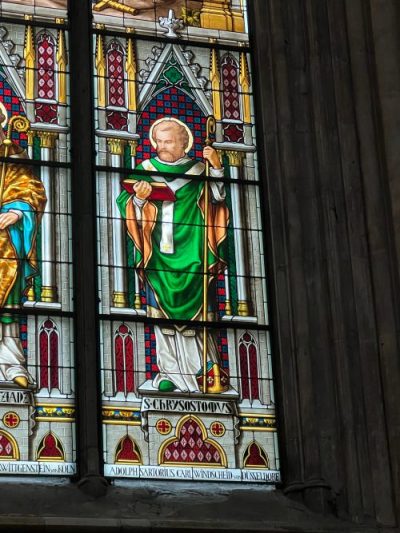
John Chrysostom from Cologne Cathedral

Two Figures of Their Own Times: Lives of Libanius and John Chrysostom

Libanius,[1] a key figure in fourth-century Antioch, offers invaluable insights into the city’s complex social and religious landscape in this period. Our primary source for understanding his life comes from his own writings. Especially the work titled Autobiography, Oration 1,[2] (published first in 374 CE, and later revisited)[3] in modern editions, which appears as a sophistic essay on one’s own Fortune (Tyche, τυχή).[4] Apart from this, his orations, his letter collection (one of the most extensive ones that survived from antiquity),[5] and Eunapius’ Lives of Philosophers and Sophists provide valuable insights about his life.[6] All these accounts expose a man whose thinking was deeply embedded in the traditions of Hellenism.[7]

Okumaya devam et →

Constructing Narratives and Fourth Century Antioch: History, Memory, and Myths

This chapter probes how Libanius and John Chrysostom dealt with Antioch’s past in their conceptualization of the city. In Late Antiquity, Averil Cameron aptly writes, “the past was so real that it was subject of intense competition.”[1] The writings of both authors strongly corroborate this statement. They constantly employed, manipulated, and reinterpreted the city’s history while forming contesting ideals of their own regarding Antioch. Libanius featured in his writings the Hellenistic history of the city and Greek myths[2] associated with it. He engaged with the already-existing traditions, myths, and narratives. Hence, his ideal of Antioch was drawn from the traditional repertoire of gods, mythical heroes, and quasi-mythical historical narratives of Antioch’s Hellenistic past. His interpretation of the city’s history mostly omitted narratives other than these. Even the Roman history of the city was overshadowed, and Christianity does not find a place in his writings beyond some vague implications.[3] We will see how he promoted Greek myths in his narratives about the time predating the actual founding of the city by Seleucus Nicator. In a way, according to him, these narratives revealed how the city’s pre-history and Hellenistic past had pointed to the city’s fourth-century grandeur and how, from the very beginning, Antioch was the chosen place of Greek heroes and Olympian gods, Antioch’s prosperity was tightly connected to the favor of these gods. These gods had always favored Antioch and protected her. In contrast, in John Chrysostom’s vision of Antioch, the Christian God replaced these Greek gods. Chrysostom’s narratives, opposing Libanius’ conceptualization, portray Antioch as a Christian city. Contrary to what Greek myths pointed to, in John Chrysostom’s narratives, Antioch was a city chosen by the Christian God, and Greek heroes are replaced by saints and martyrs who draw their strength from God. In this conceptualization, this time, it was not the gods who guaranteed the prosperity of Antioch, but the Christian God and his saints and martyrs. Chrysostom had a conceptualization of a city which is the stronghold of Christian religion, guarded by the one and true Christian God.[4]

Okumaya devam et →
The History of the Church by Eusebius and Ecclesiastical History of the English People by Venerable Bede

Eusebius’ The History of the Church, and nearly four centuries later, St. Bede’s The Ecclesiastical History of the English People opened new chapters in the long history of the historiographical tradition. Both works dealt with the formation of the church in different geographies and different periods: Eusebius concerned himself with the broader Eastern Mediterranean world and started his account with the birth of Jesus, whereas Bede began his account with Caesar’s invasion of Britain and covered the formation of the church in Anglo-Saxon England. Even though they followed the historiographical tradition established formerly, their histories were the prominent examples of the genre of church history in historiography, and they represented a divergence from the established historiographical traditions. This paper in detail presents Eusebius’s The History of the Church and Bede’s The Ecclesiastical History of the English People and gives illustrative quotes from both works to indicate the mindset of the mentioned historians. It also aims to discuss the primary motivations behind these historians to construct these particular historical narratives and show how they differed from the previous works of historiography. Moreover, this paper will discuss these historians respectively, starting from Eusebius.

Okumaya devam et →

A City Where the Last Hopes Gathered: Late Byzantine Mistra and Peloponnese and Their Functions and Reception by the Contemporaries

Cyriac of Ancona, considered by some as the founding father of modern classical archaeology, while traveling in the winter of 1447-48 in and around ancient Sparta and Mistra, wrote in his diaries the following verses that he says he heard from Calliope, singing in their “most delightful Italian tongue:” “Great Laconian city of Sparta,/ the glory of Greece, once example to the world/ of warfare and of chastity; gymnasium and temple/ and mirror and font of every noble virtue;/ if I contemplate your constitution, customs/ and human law together with you other moral virtues,/ then gaze upon you on the Eurotas, suddenly/ I exclaim to you patron Diana’s chorus:/ ‘Where are your excellent Lycurgus, where the Dioscuri,/ the dire twins, Castor and Pollux,/ Anaxandridas, Orthryadas and Gylippus,/ Eurystus and Leonidas? Where do you dwell/ son of Atreus and Pausanias, o famous leader, / Lysander, Aristo, Agesilaus, and Xanthippus? / Neither in Rome, nor with Philip,’/ it said: ‘But it is your tawdry age. I assign/ the turn to Mistra, under the leadership of Constantine.”[1] 

Okumaya devam et →