3.511–18
cognita res meritam vati per Achaidas urbes
attulerat famam, nomenque erat auguris ingens;
spernit Echionides tamen hunc ex omnibus unus
contemptor superum Pentheus praesagaque ridet
verba senis tenebrasque et cladem lucis ademptae 515
obicit. ille movens albentia tempora canis
‘quam felix esses, si tu quoque luminis huius
orbus’ ait ‘fieres, ne Bacchica sacra videres! 518
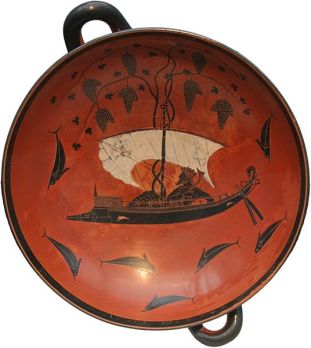
Exekias, Dionysos in a ship, Attic black-figure kylix, ca.530 BCE, Staatliche Antikensammlung, Munich.
After this has been known, the well-deserved fame of the prophet had been driven through the Greek cities and the reputation of the prophet was immense. However, out of everyone, only Pentheus, the Son of Echion, despised him and he, the despiser of the Gods above, laughed at portending words of the old man and exposes his darkness and his misfortune of losing his sight. Tiresias, shaking his temple, whitened with his old age, said: “How fortunate you would be if you also were deprived of this light so that you would not see the Bacchic sacred rites!
3.519–26
namque dies aderit, quam non procul auguror esse,
qua novus huc veniat, proles Semeleia, Liber, 520
quem nisi templorum fueris dignatus honore,
mille lacer spargere locis et sanguine silvas
foedabis matremque tuam matrisque sorores.
eveniet! neque enim dignabere numen honore,
meque sub his tenebris nimium vidisse quereris ’. 525
talia dicentem proturbat Echione natus.
For indeed the day, which I foretell is not far away, and in which the new God, Liber, offspring of Semele, arrives and unless you consider him worthy of honor of temples, you, torn to pieces, will be scattered to thousands of places and you shall stain the woods and your mother and sisters of your mother with your blood. It shall happen! For you will not honor the god and you will lament that I, in this darkness, had seen beyond measure.” Pentheus repelled him who is speaking such as.
3.527–37
dicta fides sequitur, responsaque vatis aguntur.
Liber adest, festisque fremunt ululatibus agri:
turba ruit, mixtaeque viris matresque nurusque
vulgusque proceresque ignota ad sacra feruntur. 530
‘Quis furor, anguigenae, proles Mavortia, vestras
attonuit mentes?’ Pentheus ait; ‘aerane tantum
aere repulsa valent et adunco tibia cornu
et magicae fraudes, ut, quos non bellicus ensis,
non tuba terruerit, non strictis agmina telis, 535
femineae voces et mota insania vino
obscenique greges et inania tympana vincant?
The truth followed the words, and the oracles of the soothsayer came true. Liber came, and the fields rumbled with merry yellings. The crowd rushed, mothers and young women intermingled with men, and the ordinary people intermingled with the noble, all) hastened to the unknown holy places. And Pentheus said: “You offsprings of the dragon, you descendants of Mars, which madness has stunned your minds? Are the bronze instruments struck with bronze, the pipes with curved horn, and the magical deceits so strong that the feminine voices, the madness caused by wine, the filthy crowds and the worthless drums overcome those whom neither the sword of war, nor the war-trumpets, nor the armies with unsheathed spears have terrified.
3.538–50
vosne, senes, mirer, qui longa per aequora vecti
hac Tyron, hac profugos posuistis sede penates,
nunc sinitis sine Marte capi? vosne, acrior aetas, 540
o iuvenes, propiorque meae, quos arma tenere,
non thyrsos, galeaque tegi, non fronde decebat?
este, precor, memores, qua sitis stirpe creati,
illiusque animos, qui multos perdidit unus,
sumite serpentis! pro fontibus ille lacuque 545
interiit: at vos pro fama vincite vestra!
ille dedit leto fortes: vos pellite molles
et patrium retinete decus! si fata vetabant
stare diu Thebas , utinam tormenta virique
moenia diruerent, ferrumque ignisque sonarent! 550
Should I admire you old-men, who had sailed far away through the seas, you built Tyre in this place, you set down fugitive household gods here, and know you let them be seized without war. Should I admire you younger ones, more vigorous and nearer to my age, who is suitable to hold weapons but not the thyrsus, and to be covered with the helmet, not with ivy leaves? I ask you, remember from which roots you have been created and take the soul of that serpent who alone has destroyed many men. That serpent has perished for his spring and pool, and you all defeat for your own glory! It has carried mighty men to death, but you all beat weak ones and preserve the dignity of your fathers! If the fate is preventing Thebes to stand still if only the war-engines and soldiers would demolish its walls and the fire and the sword would resound.
3.551–61
essemus miseri sine crimine , sorsque querenda,
non celanda foret, lacrimaeque pudore carerent ;
at nunc a puero Thebae capientur inermi,
quem neque bella iuvant nec tela nec usus equorum,
sed madidus murra crinis mollesque coronae 555
purpuraque et pictis intextum vestibus aurum,
quem quidem ego actutum (modo vos absistite) cogam
adsumptumque patrem commentaque sacra fateri.
an satis Acrisio est animi , contemnere vanum
numen et Argolicas venienti claudere portas: 560
Penthea terrebit cum totis advena Thebis?
We would be miserable without blame, and the fortune must be bewailed, but not be concealed, and (our) tears would be free from dishonor. But now Thebes will be seized by an unarmed boy whom neither war, nor spears, nor cavalry delight, but hair soaked with myrrhs, gentle chaplets, and purple cloths interweaved with gold please, and whom I also compel immediately to confess that his divine origin is falsely claimed and the sacred rites were fabricated. Acrisius had enough courage to despise the false god and shut the gates of Argos to the new-comer: Shall this new one terrify Pentheus and all the Thebes?”
3.562–71
ite citi’ (famulis hoc imperat), ‘ite ducemque
attrahite huc vinctum! iussis mora segnis abesto!’
hunc avus, hunc Athamas, hunc cetera turba suorum
corripiunt dictis frustraque inhibere laborant. 565
acrior admonitu est inritaturque retenta
et crescit rabies moderaminaque ipsa nocebant:
sic ego torrentem, qua nil obstabat eunti ,
lenius et modico strepitu decurrere vidi;
at quacumque trabes obstructaque saxa tenebant, 570
spumeus et fervens et ab obice saevior ibat.
“Go quickly” (he ordered this to his servants), “go and drag the leader (!), having been tied, hither! Let the delay be away from my orders!” His grandfather (Cadmus), Athamas, and the rest of the attendants of his own rebuked him with words and they strived to restrain him in vain. His rage became more severe with warnings, and it, having been restrained, was provoked and it thrived, they incited it with hinderance. Likewise, I saw a current of a river flows gently and with a moderate murmur where nothing was obstructing its flowing, but wherever logs and stones, placed in the way, were holding it, the torrent, because of the obstacles, it was flowing, foamy and boiling, more fiercely.
3.572–81
ecce cruentati redeunt et, Bacchus ubi esset,
quaerenti domino Bacchum vidisse negarunt;
‘hunc’ dixere ‘tamen comitem famulumque sacrorum
cepimus’ et tradunt manibus post terga ligatis 575
sacra dei quendam Tyrrhena gente secutum.
adspicit hunc Pentheus oculis, quos ira tremendos
fecerat, et quamquam poenae vix tempora differt,
‘o periture tuaque aliis documenta dature
morte’, ait, ‘ede tuum nomen nomenque parentum 580
et patriam, morisque novi cur sacra frequentes!’
Behold! They, stained with blood, returned, and when their master asks for where Bacchus is they have denied that they have seen him, but they said, “Here, yet we have captured his devotee and servant of sacred rites,” and while his hands are tied behind his back, they hand over him who follows the rites of the God and Etruscan in origin. Pentheus gazed at him with his eyes, which the anger had made terrible, and though he scarcely puts off the time of punishment, he said, “You, who will vanish, and you, who will give others a lesson by death, tell your name and your parent’s name and your country, and why you frequent the rites of the new religion?”
3.582–91
ille metu vacuus ‘nomen mihi’ dixit ‘Acoetes,
patria Maeonia est, humili de plebe parentes.
non mihi quae duri colerent pater arva iuvenci ,
lanigerosve greges, non ulla armenta reliquit; 585
pauper et ipse fuit linoque solebat et hamis
decipere et calamo salientis ducere pisces.
ars illi sua census erat; cum traderet artem,
‘accipe, quas habeo , studii successor et heres’,
dixit ‘opes’, moriensque mihi nihil ille reliquit 590
praeter aquas: unum hoc possum appellare paternum.
He, devoid of fear, said, “My name is Acoetes and Etruria is my country, and my parents were from humble origin. My father has left me neither arable lands which durable young bullocks till, nor wool-bearing flocks, nor any cattle for plowing. He himself was poor, and he used to entrap leaping fish with rope and hooks and draw them with a fishing rod out of the water. His skill was his wealth. When he taught, his skill to me, he said, ‘Receive, my wealth, which I have, you, my successor and the heir of my work.’ When he died, he left me nothing except for the water. I can call this my sole inheritance.
3.592–99
mox ego, ne scopulis haererem semper in isdem ,
addidici regimen dextra moderante carinae
flectere et Oleniae sidus pluviale Capellae
Taygetenque Hyadasque oculis Arctonque notavi 595
ventorumque domos et portus puppibus aptos.
forte petens Delon Chiae telluris ad oras
applicor et dextris adducor litora remis
doque levis saltus udaeque inmittor harenae:
I soon, in order not to stick into the same rocks always, learned also to direct the ruddle of the ship, after I moderated it rightly, I marked the rainy constellation of Olenian-goats, and the Taygete, the Hyades, and the Great and Little Bear with my eyes, and also the houses of the winds and the harbors suitable for the ships. By chance, sailing to Delos, I steered into the coasts of the land of Chios and I sailed my ship to the beach with the right-hand oars, I gave a quick jump and I leaped into the wet sands.
3.600–10
nox ibi consumpta est; aurora rubescere primo 600
coeperat: exsurgo laticesque inferre recentis
admoneo monstroque viam, quae ducat ad undas ;
ipse quid aura mihi tumulo promittat ab alto
prospicio comitesque voco repetoque carinam.
“adsumus en” inquit sociorum primus Opheltes, 605
utque putat, praedam deserto nactus in agro,
virginea puerum ducit per litora forma.
ille mero somnoque gravis titubare videtur
vixque sequi; specto cultum faciemque gradumque:
nil ibi, quod credi posset mortale, videbam. 610
The night has been spent there: and as soon as the dawn had begun to turn red: I got up and exhorted to carry fresh water in and I indicated the road which takes to the stream: I myself, looked forward from a hill what the wind foretells to me, I called my comrades and I returned to the ship. Opheltes, the leading of the companions, said, ‘Behold! We are here,’ and he was leading a boy with a maidenly form through the strand, but as he believes, he had found pillage in the deserted field. He, the boy, seems to stagger laden with wine and sleep and to follow with difficulty. I gazed at his refinement, countenance, and his gait and I saw nothing in his appearance which could be entrusted to a mortal.
3.611–20
et sensi et dixi sociis: “quod numen in isto
corpore sit, dubito; sed corpore numen in isto est!
quisquis es, o faveas nostrisque laboribus adsis;
his quoque des veniam!” “pro nobis mitte precari!”
Dictys ait, quo non alius conscendere summas 615
ocior antemnas prensoque rudente relabi.
hoc Libys, hoc flavus, prorae tutela, Melanthus,
hoc probat Alcimedon et, qui requiemque modumque
voce dabat remis, animorum hortator, Epopeus,
hoc omnes alii: praedae tam caeca cupido est. 620
I soon discerned and said to my fellows: ‘I am in doubt for which God is in that body, but in that body, there is a god. Whoever you are, I pray to be favorable to us and help us in our toils, also give indulgence to these men!’ But Dictys, no one was swifter than him to mount to the highest sail yards and to slide back while holding a rope, said, ‘Do not pray for us!’ And Libys, and blond Melanthus, the guardian of the prow, and Alcimedon approve what Dictys said, and so Epopeus, the encourager of the souls, who give to the oars rest and rhythm with his voice, and all of the others approved: so blind was the desire of booty.
3.621–33
“non tamen hanc sacro violari pondere pinum
perpetiar” dixi; “pars hic mihi maxima iuris ”
inque aditu obsisto: furit audacissimus omni
de numero Lycabas, qui Tusca pulsus ab urbe
exilium dira poenam pro caede luebat; 625
is mihi, dum resto, iuvenali guttura pugno
rupit et excussum misisset in aequora, si non
haesissem, quamvis amens, in fune retentus.
inpia turba probat factum; tum denique Bacchus
(Bacchus enim fuerat), veluti clamore solutus 630
sit sopor aque mero redeant in pectora sensus,
“quid facitis? quis clamor?” ait “qua, dicite, nautae,
huc ope perveni? quo me deferre paratis?”
Then I said, ‘I will, nevertheless, not permit that this ship is outraged by sacred burden, I have the greatest part of right here,’ and I resist to entrance into: but then Lycabas, the most presumptuous of the all from the band, and who, having banished from Tuscan city, was suffering exile punishment in return for an awful murder, raged. But while I am opposing, he grasped my throat” with his powerful fists and if I, having been held, had not clung on the rope, though senseless, he would have dispatched me, having forced away, into the water. The wicked crowd approved this deed; then Bacchus (for he had been Bacchus), as if his drowsiness has been untied by a loud call and the senses return to him from drunkenness, said: ‘What are you doing? What is this noise? Tell me, O sailors, by what means I came here? Where do you design to take me?’
3.634–43
“pone metum” Proreus, “et quos contingere portus
ede velis! ” dixit; “terra sistere petita”. 635
“Naxon” ait Liber “cursus advertite vestros!
illa mihi domus est, vobis erit hospita tellus”.
per mare fallaces perque omnia numina iurant
sic fore meque iubent pictae dare vela carinae.
dextera Naxos erat: dextra mihi lintea danti 640
“quid facis, o demens? quis te furor”, inquit “Acoete”,
pro se quisque, “tenet? laevam pete!” maxima nutu
pars mihi significat, pars quid velit ore susurro.
Proreus said, ‘Leave the fear off and relate which harbor you want to arrive at, and you will be placed in the region that has been aimed.’ And Liber said, ‘Direct your course to Naxos! It is my home, and this land will be hospitable to you.’ And the deceitful men swore for the sea and all the Gods, that this will be in this way and they ordered me to ‘give the sails of the painted ship’ Naxos was on the right; while I was setting the sail to the right, each one of them asked, ‘What are you doing you, mad man? You Acoetes, what madness did grasp you? Steer to the left!’ Most of them point out what they are willing with a nod; while the others with a whispering mouth.
3.644–55
obstipui “capiat ”que “aliquis moderamina!” dixi
meque ministerio scelerisque artisque removi. 645
increpor a cunctis, totumque inmurmurat agmen;
e quibus Aethalion “te scilicet omnis in uno
nostra salus posita est!” ait et subit ipse meumque
explet opus Naxoque petit diversa relicta .
tum deus inludens, tamquam modo denique fraudem 650
senserit, e puppi pontum prospectat adunca
et flenti similis “non haec mihi litora, nautae,
promisistis” ait, “non haec mihi terra rogata est!
quo merui poenam facto? quae gloria vestra est,
si puerum iuvenes, si multi fallitis unum?” 655
I have been astonished and said, ‘Let someone else take the helm!’ and I put off myself from the service of their wicked deed and the work of my practical skill. I am resounded by the whole and the whole band murmured against me: and one of them, Aethalion said, ‘It is certain (!) that all our lives are fixed to you alone!’ and he himself took my place and performed my toil, and while abandoning the course to Naxos, he directed his course to the opposite side. Then the God, mocking as if he perceived their crime only then, looked at the sea from the curved stern, and looked like someone crying, told, ‘O sailors, they are not the strands that you have promised and not the lands requested by me! Did I deserve this punishment for what deed? What glory is yours, if you young men deceive a boy, you many, deceive one?’
3.656–65
iamdudum flebam: lacrimas manus inpia nostras
ridet et inpellit properantibus aequora remis.
per tibi nunc ipsum (nec enim praesentior illo
est deus) adiuro, tam me tibi vera referre
quam veri maiora fide : stetit aequore puppis 660
haud aliter quam si siccum navale teneret.
illi admirantes remorum in verbere perstant
velaque deducunt geminaque ope currere temptant:
inpediunt hederae remos nexuque recurvo
serpunt et gravidis distinguunt vela corymbis. 665
I was crying long since: but the wicked crew laughed at my tears and struck the sea with hastening oars. Now I swear to you Pentheus by the god himself (for in fact no god is more present than he), that the thing I tell you are such a truth is that it is greater than belief of truth: the ship lasted by the water, as if that it holds a dry-dock. The astonished sailors persisted in lashing the oars and they unfurled the mainsail and attempted to hasten the ship with double aid: ivies hindered the oars, and they crawled entwining and they embellished the sail with a cluster of ivy berries.
3.666–75
ipse racemiferis frontem circumdatus uvis
pampineis agitat velatam frondibus hastam;
quem circa tigres simulacraque inania lyncum
pictarumque iacent fera corpora pantherarum.
exsiluere viri, sive hoc insania fecit 670
sive timor, primusque Medon nigrescere coepit
corpore et expresso spinae curvamine flecti.
incipit huic Lycabas “in quae miracula” dixit
“verteris?” et lati rictus et panda loquenti
naris erat, squamamque cutis durata trahebat. 675
And the God’s himself, bearing clustering grapes and surrounding his forehead with wine-leaves moved his thyrsus wrapped with a leafy branch: and all around him tigers, lifeless figures of lynxes, and wild spotted bodies of panters cast. The men leaped out, either madness has made this, or fear; and the first Medon began to become black by body, and to be curved with the arc of his back-bone. Lycabas began to speak him: ‘To which marvel are you turned into?’ And as he was speaking, his gaping jaws became wide and his nose became curved, his skin, having been hardened, became scaly.
3.676–86
at Libys obstantis dum vult obvertere remos,
in spatium resilire manus breve vidit et illas
iam non posse manus, iam pinnas posse vocari.
alter ad intortos cupiens dare bracchia funes
bracchia non habuit truncoque repandus in undas 680
corpore desiluit: falcata novissima cauda est,
qualia dividuae sinuantur cornua lunae.
undique dant saltus multaque adspergine rorant
emerguntque iterum redeuntque sub aequora rursus
inque chori ludunt speciem lascivaque iactant 685
corpora et acceptum patulis mare naribus efflant.
And Libys, while he was wishing to turn opposing oars against the water, he saw that his hands were shrinking and that they could not be called hands, but rather they could be called fins. The other, wishing to extend his arms to the twisted ropes, had no arms, and he bends backward, has jumped overboard to the waves with his mutilated body: the newest tail was curved, just as the horns of the half-moon are curved. And on all sides, they bounded and drizzled with many sprays and they emerged once more and turned back under the water again and they played, giving the impression of dance, and they threw their bodies friskily and they breathed out taken water with their wide-open nostrils.
3.687–95
de modo viginti (tot enim ratis illa ferebat)
restabam solus: pavidum gelidoque trementem
corpore vixque meo firmat deus “excute” dicens
“corde metum Dianque tene!” delatus in illam 690
accessi sacris Baccheaque sacra frequento’.
‘Praebuimus longis’ Pentheus ‘ambagibus aures’,
inquit ‘ut ira mora vires absumere posset .
praecipitem, famuli, rapite hunc cruciataque diris
corpora tormentis Stygiae demittite nocti!’ 695
Out of twenty men, that had been there little while ago, (for that ship was carry so many men) I left alone; the God encouraged me, who was fearful and trembling with a frozen body that was hardly my own, saying; ‘Banish fear from you heart and sail to Naxos!’ and having been carried to Naxos, I entered to the sacred rituals of Bacchus and I still frequent Bacchic sacred rites.” Then Persues said, ‘We have lent our ears to your long riddle so that our anger might exhaust its strenth with delay. You servants, drag him rapidly and sent him down to the darkness of Styx with his body having been tortured with your awful racks.’
3.696–707
protinus abstractus solidis Tyrrhenus Acoetes
clauditur in tectis; et dum crudelia iussae
instrumenta necis ferrumque ignesque parantur,
sponte sua patuisse fores lapsasque lacertis
sponte sua fama est nullo solvente catenas. 700
perstat Echionides, nec iam iubet ire , sed ipse
vadit ubi electus facienda ad sacra Cithaeron
cantibus et clara bacchantum voce sonabat.
ut fremit acer equus, cum bellicus aere canoro
signa dedit tubicen pugnaeque adsumit amorem, 705
Penthea sic ictus longis ululatibus aether
movit, et audito clamore recanduit ira.
And immediately, Lydian Acoetes, having dragged away, was shut in a solid prison; but the story is that while the severe instruments, the sword, and the fire were being prepared for the ordered death, the doors were spontaneously open and the chains slipped from his upper arms, even though no one untied them. The son of Echion persisted, this time he did not order others to go, but he himself rushed to where Cithaeron, selected to the sacred rites that have to be done, was resounding with songs and loud utterances of bacchantes. Like an eager horse, when the trumpeter gives the sign of war with the melodious bronze growls, and it receives the passion of battle, in this way the air, struck with howlings for a long time, set Pentheus in motion, and his anger had whitened by heard shouts.
3.708–18
monte fere medio est, cingentibus ultima silvis ,
purus ab arboribus, spectabilis undique, campus:
hic oculis illum cernentem sacra profanis 710
prima videt, prima est insano concita cursu,
prima suum misso violavit Penthea thyrso
mater et ‘o geminae’ clamavit ‘adeste sorores!
ille aper, in nostris errat qui maximus agris,
ille mihi feriendus aper’. ruit omnis in unum 715
turba furens; cunctae coeunt trepidumque sequuntur,
iam trepidum, iam verba minus violenta loquentem,
iam se damnantem, iam se peccasse fatentem.
There is a field at the half of the way that goes to mountain, although forests surround its edges, it is clean from fig-trees, and visible from everywhere: here, the first one saw him witnessing sacred rites with his profane eyes, the first one who was roused by his mad running, and the first violated him with her hurled thyrsus was his own mother, and she shouted, “O my two sisters, come! This very great boar, who wanders in our fields, must be killed by me.” The whole raging group rushed into the one; and the whole came together, and followed panicked Pentheus, now speaking less violently, condemning himself, and confessing that he himself has committed a fault.
3.719–28
saucius ille tamen ‘fer opem, matertera’ dixit
‘Autonoe! moveant animos Actaeonis umbrae!’ 720
illa, quis Actaeon , nescit dextramque precantis
abstulit, Inoo lacerata est altera raptu.
non habet infelix quae matri bracchia tendat,
trunca sed ostendens dereptis vulnera membris
‘adspice, mater!’ ait. visis ululavit Agave 725
collaque iactavit movitque per aera crinem
avulsumque caput digitis conplexa cruentis
clamat: ‘io comites, opus hoc victoria nostra est!’
He wounded, however still said, “Help me, O aunt Autonoe! May the ghosts of Actaeon stir your soul.” But she, Autonoe, did not know who Actaeon was and removed his begging right hand, and the other was mangled by the violent rending of Ino. This miserable one had no forearms to extend his mother, but displaying his mutilated wounds and removed limbs, he said, “Look, mother!” But when his wounds have been seen by her, Agave howled and she shook her neck, and moved her hair through the air, and grasping the torn head with her bloody fingers, she shouted: “O comrades, this deed is our victory!”
3.729–33
non citius frondes autumni frigore tactas
iamque male haerentes alta rapit arbore ventus, 730
quam sunt membra viri manibus direpta nefandis.
talibus exemplis monitae nova sacra frequentant
turaque dant sanctasque colunt Ismenides aras.
Like the wind tears leafy branches, touched by the cold of autumn and soon barely clinging, from the lofty trees, the limbs of Pentheus have been torn asunder by blasphemous hands. Having been warned by such kind of example, Theban women frequent the new sacred rites, offer incenses and take care of sacred altars.
The main source for this translation: Ingo Gildenhard and Andrew Zissos, Ovid, Metamorphoses, 3.511–733. Latin Text with Introduction, Commentary, Glossary of Terms, Vocabulary Aid and Study Questions. Cambridge, UK: Open Book Publishers, 2016, https://doi.org/10.11647/OBP.0073

