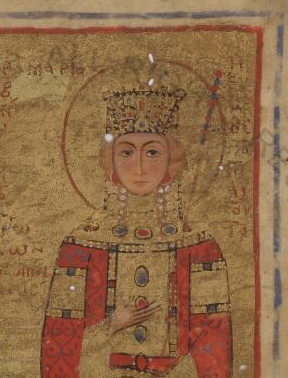
Empress Maria from Vat. gr. 1176, f. IIr
In the history of Byzantine Empire, 11th and 12th centuries were exceptional regarding the number of powerful women who steered the empire or had an impact on the imperial policies,[1] although previous centuries also encountered mighty empresses such as Theodora, wife of Justinian II. [2] Starting from Zoe Porphyrogenite (1028-50), some of these powerful women held the power directly at their hands, whereas some of them held it more indirectly, some acted as the regents for their sons, the nominal emperor, for example. In either case, these powerful rulers of Byzantium say a lot about the political and social transformations in the 11th and 12th centuries, as well as they, contribute much for the women studies in the Byzantine period.[3] Despite the multitude of powerful women rulers who sit in the capital city, Constantinople, this paper deals with one of them: Maria of Antioch, or with the monastic name she adopted for herself Maria-Xene. Maria of Antioch, became the wife of Manuel Komnenos in 1161, after the wedding ceremony which was held at Hagia Sophia.[4] She was the daughter of Raymond of Poitiers (b. 1099-1149), the prince of the Latin Principality of Antioch, and Constance of Antioch (b. 1128 –1163).[5] Hence, she was Latin in origin, that was both an advantage for the choice of Manuel I for marriage, accordingly with his pro-Latin policies,[6] and a disadvantage for her after Manuel I’s reign, given the fact that her origin was among the factors, although not directly, that stimulated the turmoil in Constantinople during her regency.[7] In this respect, the case of Maria of Antioch is discussed around particular subjects in this paper, one is the political sphere around her, and her role in it, and the second topic is her position in the broader concept of womanhood in Byzantium. Hence, the aim of the work here is to investigate how can her incidence be regarded round women’s roles in Byzantine imperial palace and the state policies issued from it. This paper suggests that her example gives strong evidence for the fact that she had an extensive power as long as she was the mother-regent of the young emperor, Alexios II, and her beauty was not just a physical trait, but also a legitimizing factor for the imperial claims in the eyes of Byzantines. Many primary sources testify what is said above, and to pursue aforesaid question, this paper first gives a general introduction about the marriage between Maria-Xene and Manuel I, the decisive role of her beauty in this affair, and about Maria’s role during the period when Manuel I was still alive, secondly it deals with the circumstances during her regency for her son.
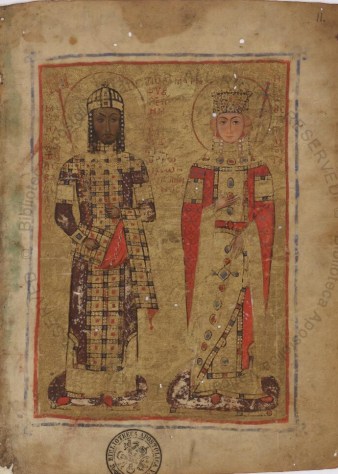
Empress Maria of Antioch with Emperor Manuel I, Vat.gr. 1176, f. IIr
Manuel I’s pro-Latin policies and his extensive involvement with the affairs related to the Latin principalities in the Middle East[8] explain his preference for westerner wives both for his two marriages. Bertha-Irene of Sulzbach, sister-in-law of Conrad III,[9] the first wife of Manuel was German,[10] and after her death in 1159, even though Choniates says that Manuel I ‘grieved bitterly, looking upon her demise as if a limb had been torn from his body, and his lamentation was like the roar of a lion’,[11] he began to look for a second wife, since ‘he desired to hear himself called the father of a son.’[12] Manuel I and Bertha-Irene had two daughters; one of them Maria survived, and later she also attended political affairs in Constantinople, but the other one could live no more than four years.[13] William of Tyre relates the negations about the marriage in detail; after Bertha-Irene’s death, a group of imperial envoys, that was led by a relative of the emperor, John Kontostephanos, arrived to Baldwin III, king of Jerusalem, with ‘a letter with golden seal’, to ask him to choose either Melisende of Tripoli, or Maria of Antioch to be the imperial consort[14]:
“Know, O dearest friend, most beloved of our empire, that our imperial consort, the illustrious Irene, of precious memory in the Lord, has finished her allotted days on earth and henceforward dwells with the spirits of the elect. She has left us an only daughter as the heir to the empire. But as we have no male offspring, we are filled with solicitude about the succession and have frequently held earnest conference with the most illustrious nobles of the court in regard to a second alliance. With the consent and approval of all our princes, it has finally been judged desirable that we take as our imperial consort a lady of your lineage, since, of all our empire, we hold you in the deepest affection. Whomsoever of your kinswomen you shall choose for us, be she the sister of the illustrious count of Tripoli, or the younger sister of the magnificent prince of Antioch, her we shall receive, with entire confidence in your loyalty and your choice, as, by the will of God, our imperial consort and companion in the realm.”[15]
Baldwin III designated Melisende of Tripoli to marry the emperor, however, contrary to the former promises and all the preparations, the marriage was constantly delayed and eventually, it was canceled and Byzantine court turned to arrange a marriage with Maria of Antioch. William of Tyre accuses the Byzantine court, or with his words the Greeks, of delaying the marriage constantly and eventually canceling it, whereas Kinnamos says that Melisende of Tripoli was suffering from serious diseases that make the marriage impossible.[16] However, in either case, it is obvious that the relationship with these Eastern Franks was so important for Manuel I’s policies that he asked Baldwin III to choose his new wife from the alternatives that were also from Franks, as Angold also points out.[17] It is also obvious that an alliance with the principality of Antioch was deemed more advantageous for the Byzantine court, and for the imperial policies at that time, hence the marriage between an Antiochian-Western princess and a Constantinopolitan emperor was arranged.[18] As important as her Western origin was the beauty of the new empress. All the sources agree upon her exceptional beauty; for the case of Melisende of Tripoli, we know from William of Tyre that ‘the Greek’ officials examine each detail about the princess, even ‘the most secret physical characteristics’.[19] Moreover, given the fact that ‘beautiful’ was the most common adjective used for imperial women,[20] it is not surprising that the imperial bride receives from everywhere praises for her beauty. Choniates writes that she had an incomparable beauty, likening her ‘laughter-loving, golden Aphrodite, the white-armed and ox-eyed Hera, the long-necked and beautiful-ankled Laconian’[21], whereas Kinnamos says that when imperial officer Basil Kamateros was sent to Antioch to view the two daughters of Raymond of Antioch, he decided Maria was ‘more beautiful’, and envoy’s later testimonies agreed with what had been stated before. According to Byzantines, as he says, no one in their time had ever seen such a beauty.[22] Eustathios of Thessaloniki, who was the most critical of the sources about her, even accuses her of ‘veiling the sunshine of her charms in a spiritual manner with a cloud of dark garments.’[23] Her pulchritude and charm were the reasons for not only the decision of Manuel I but also among reasons of her centrality for the power struggles that aroused after the death of Manuel I. According to Choniates, after his death, his relatives and companions neglected everything about the empire, strove just for the affection of the empress. He says that they ‘passionately desired the empress and wooed her, eagerly seeking to win her love in return’,[24] criticizing them for ‘arranging their hair in harming curls, rubbing themselves with sweet oils, and effeminately wearing necklaces set with precious gems.’[25] This attraction of her is found another passage from his account in which he says that ‘she pulled in everyone as though on a line by the radiate of her appearance, her pearly countenance, her even disposition, candor, and charm of speech’.[26] Even though Choniates finds the reason because of which the empire felt into turmoil in the relationship between Alexios protosebastos, nephew of Manuel I, he also lamented after Maria of Antioch was strangled by Andronikos I Komnenos, who seized the throne in 1183, saying that she was the ‘sweet light and a vision of beauty unto men’.[27] For Andronikos I Komnenos must have deemed the paintings of her so dangerous, or must have thought that her beauty had such a long-lasting effect that, after her strangulation, he ordered her paintings to be altered so that she was depicted as an old woman because he was abstaining from the sentiments that aroused after the spectators looked those ‘radiant and very beautiful portrayals’ of her.[28]
Andronikos’ precaution had a history since once Maria of Antioch and her lover Alexios protosebastos were the archenemies of him, involving much in the politics. However, when Manuel I was still alive, she was not much visible in the political stage as well as in contemporary sources. Just for two instances, during the period from the marriage till the death of Manuel I, the sources refer her; when she gave birth to a long-awaited male heir to the throne, Alexios, and when she revealed the treachery of court translator, Aaron. Barbara Hill, in this point, advocates ‘the pattern of invisibility as a wife’. [29] After the death of an emperor, this pattern is replaced by the pattern of ‘approved exercise of authority as a mother.’[30] Contemporary sources prove that this model complies with the case of Maria of Antioch. The incidence, that Maria, who, having Western origins, knew their language, revealed the treachery of Aaron during when westerner envoys were exhorted by him not to give in the conditions of the emperor too quickly, clearly shows that Maria-Xene attended the receptions in which the foreign ambassadors were received.[31] However, she was cognizably overshadowed by her husband. Indeed, this was true also when she took a lover with her to conduct the regency for her son, Alexios II, as Hill argues.[32]
At this point, it is useful to turn to the theories of Barbara Hill regarding womanhood in Byzantium for the sake of explaining the power dynamics behind those years which followed the death of Manuel I. According to Hill, the origins of the power of the empresses, the ‘ideologies’ behind them, can be divided into two big groups; one group of women consists of Zoe and Theodora, who were ruling independently since the power they had stemmed from their dynastic rights, and their blood ties made them independent since they were the daughters of Constantine VIII, one of the Macedonian emperors. The other group of women, which is larger than the previous one, had their powers due to their relations with the emperor.[33] Being once the wife and then the mother of the emperor, Maria of Antioch fits into this group and in fact, the latter role that she undertook ejected her from the shadows and brought her into the prominence. It is well acknowledged that motherhood was the most important role of a woman for Byzantine ideology,[34]and in this respect, Hill also constructs ‘the ideology of widowed mother’;[35] for her, this ideology was the ‘strongest foundation for women’s power’.[36] Hill acknowledges that this ideology is also patriarchal and restrictive in its own right, it allowed women to exercise influence and power.[37]
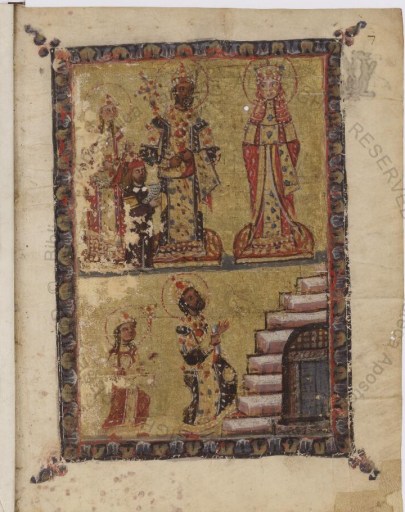
Vat.gr.1851 f. 7r., Shows Maria of Antioch top-right
Contemporary sources are also valuable to indicate how motherhood was powerful, and how it was deemed as a legitimate tool for women to rule. Choniates gave many references for Maria of Antioch and he referred her eleven times as ‘the empress’,[38] eight times as the ‘emperor’s mother’,[39] and three times as Xene,[40] which was her monastic name. Eustathios referred her as the mother more often. He spoke of her as the empress or the ‘sovereign lady’ (‘ηδέσποινα’ or ‘η βασιλις’) for four times, as Xene for once.[41] In his work yet the motherhood of her was more emphasized, in addition to that he mentioned her six times as the mother of the emperor (η του βασιλεως μητηρ),[42] he complemented the definition of her power as a mother of the emperor in some paragraphs. It is clear in his account that she was appointed as the guardian of the new emperor by Manuel I before his death[43] since it was the traditional role for widowed women as Hill states,[44] but also he adds that a council of regency, comprised of many others including the patriarch Theodosius, was formed for the young emperor. However, the patriarch was overshadowed by Maria of Antioch:
“There were others who shared in this guardianship, among whom was the man who had gained the patriarchate, Theodosius, who excelled both in virtue of character and oratory, and had been bestowed by the Church of Antioch upon the Great City as a most precious benefit. But the women took precedence both as a woman and as a mother, and from that time onwards she was the mark of everyone because of her prominence.”[45]
In one of the other paragraphs, he says that Maria of Antioch was raised into the position of ‘supreme power’ by the people,[46] while in the other one he refers her as the ‘all-powerful mother’.[47]
This power, however, did not last long. Because from the beginning of the regency, there were objections against the rule of Maria the empress. Hill argues that she could not maintain her power, because she left ‘most potent protection’,[48] namely her position as the emperor’s mother and the widow of the former emperor. She took a lover, as it is said before, from many male Komnenoi and the others who were desirous of the regency, and she was criticized for doing so by the contemporaries and by her opponents:
“Indeed, the rumor was already being bruited about, that Alexios was having sexual intercourse with the emperor’s mother and that he planned to depose the young monarch, to mount both mother and throne.”[49]
Choniates, even though he was critical of Alexios protosebastos thinking that he was not efficient as a ruler and was an ‘effeminate dullard’,[50] and of that, the reason of the whole turmoil in the empire was Maria’s choice for Alexios,[51] he was also aware that those who objected the protosebastos and Maria-Xene did not aim to protect the young emperor Alexios, but they did so because they were afraid that they might be arrested.[52] Eustathios of Thessaloniki, giving not much detail after Manuel I’s death, links all the disasters that fell upon the empire to Maria’s choice and the multitude of the claimants for the power:[53] “there collapsed at that time everything that was firm among the Greeks (Ῥωμαῖος), and that when like the sun he (Manuel I) left us, a great darkness descended upon us.”[54] Choniates gives a detailed list of opponents to the new regime; Andronikos Komnenos, who had the support of the ‘powerful and mighty’[55] people of Constantinople, his two sons, John and Manuel, Andronikos Lapardas, John Kamateros, the eparch of the city, and another Alexios Komnenos, who was the illegitimate son of Manuel I from his niece Theodora).[56] In addition to these men, the daughter of Manuel I from his first wife Bertha-Irene, Maria porphyrogenita also attended the plots against the new regime, with her husband Renier.[57] Seeing that list, the statement of Hill that says Maria could not endure against the ‘pressures of male’ rule is proven correct,[58] however, she also adds that it was not her motherhood and consequential power in regency what these people objected, but they and the people of Constantinople objected her because she became self-ordained.[59]
Moreover, her role and stance in the 12th-century politics can be traced back to her Western-Latin origins. As it is said before, Manuel’s choice for a bride that had Western origins was deliberate,[60] and his preference for an Antiochian one served his political intentions well and was also due to political conjuncture of that time.[61] However, more importantly, the people of Constantinople were aware of this origin, and opponents of her exploited this awareness.[62]They excited anti-Latin sentiments in Constantinople and culminated that hatred around Maria-Xene and Alexios protosebastos. They were accused of supporting Latins against the Greeks: [63]
“For the empress and the Protosebastos, after failing to win the affections of the Greeks, looked across to the Latins. And they incited them with gifts, and in particular, promised that they might plunder the city and place the Greeks in servitude under them; and so they actually persuaded them to get ready for war, which was prevented when Andronikos crossed the straits.”[64]
Hence, when Andronikos took the city from Maria-Xene and Alexios in 1183, a severe attack against Latins started which was narrated by William of Tyre in detail.[65] Andronicus II made later Alexios protosebastos blinded and mutilated. [66]Later, when he obtained enough support in Constantinople, he ordered both Maria-Xene, whom he had accused of treason when she unsuccessfully attempts to seek help from her sister’s husband Béla III, the king of Hungary and then Alexios I to be murdered.[67] Hence, the conditions which brought the end of the empress Maria can be seen in the tension between anti- and pro-Latin sentiments in Constantinople. In this context of conflict, the only possible two works of patronage can be linked with the empress. One is the manuscript of Vat.gr.1851, which is called ‘Epithalamion of Andronikos II.’ However, Michael Jeffreys convincingly states that this work was made to welcome new western bride for the palace of Constantinople; Agnes of Savoy, who wedded Alexios II, but later was married to Andronikos II.[68] According to Jeffreys the figure at the top-right section of page 7r is Maria of Antioch, who was, for him, ‘the chief hope of the pro-Latin cause’,[69] in this respect, welcoming her new alliance in the capital. Another hint of patronage about her, but not materialized, is found in Choniates, who says that emperor Isaac II Angelos turned the so-called house of Ioannitzes into a nunnery and that it was the intention of Maria-Xene after the death of her husband.[70]
In conclusion, Maria of Antioch or Maria-Xene, the wife of the emperor Manuel I and later the regent for her son Alexios II for three years was one of the examples of the powerful empresses of the 12th century-Komnenian period. She was a beautiful, western, and regent woman in Constantinopolitan court. All these made her reflect prevailing world-views as well as political conjunctures of that time. She was one of the examples to explain how womanhood was considered in the imperial realm. As a widowed-mother of the young emperor, Alexios II, she practiced extensive power, until she was overwhelmed by the power struggles in Byzantium. Her beauty served as an advantageous and legitimizing factor for her, both in the decision of Manuel II and the widespread opinion of the people about the empress. Her western origin as well, once a preferable trait, then became one of the main reasons for her disapproval.
Bibliography
Angold, Michael. The Byzantine Empire, 1025-1204: A Political History. 2nd ed. London: Longman, 1997.
Choniates, Nicetas. O City of Byzantium, Annals of Niketas Choniatēs. Translated by Harry J. Magoulias. Detroit: Wayne State University Press, 1984.
Eustathios of Thessaloniki. The Capture of Thessaloniki. Translated by John Melville Jones. Leiden: Brill, 2017.
Garland, Lynda. Byzantine Empresses: Women and Power in Byzantium, AD 527-1204. London: Routledge, 2011.
Hill, Barbara. “Imperial Women and The Ideology of Womanhood in the Eleventh and Twelfth Centuries.” In Women, Men, and Eunuchs: Gender in Byzantium, edited by Liz James. London: Routledge, 1997.
Hill, Barbara. Imperial Women in Byzantium: 1025-1204; Power, Patronage and Ideology. New York: Longman, 1999.
Jeffreys, Michael. “The Vernacular Εισιτηριοι for Agnes of France.” In Byzantine Papers: Proceedings of the First Australian Byzantine Studies Conference Canberra, 17–19 May 1978, edited by Elizabeth Jeffreys and Ann Moffat. Leiden: Brill, 2017.
Kinnamos, John. Deeds of John and Manuel Comnenus. Translated by Charles M. Brand. New York: Columbia University Press, 1976.
Laiou, Angeliki E. Gender, Society and Economic Life in Byzantium. Hampshire, Great Britain: Variorum, 1992.
William of Tyre. A History of Deeds Done Beyond the Sea. Translated by Emily Atwater Babcock and A. C. Krey. Vol. 2. New York: Columbia University Press, 1943.
Notes
[1] (Hill 1999, 18); (Hill 1997, 76)
[2] Information about the Byzantine empresses see: Garland, Lynda. Byzantine Empresses: Women and Power in Byzantium, AD 527-1204. London: Routledge, 2011.
[3] (Hill 1999, 18)
[4] Choniates, 66 (Translated by Harry J. Magoulias ); Kinnamos, 160 (Translated Charles M. Brand); William of Tyre, 288 (Translated by Emily Atwater Babcock and A. C. Krey)
[5] (Garland, 201)
[6] William of Tyre, 461
[7] Choniates, 72; Eustathios, 35; William of Tyre, 462-4.
[8] Choniates 72; (Angold, 217)
[9] (Garland, 199)
[10] Choniates, 65; on Bertha-Irene’s death: Kinnamos, 58; Choniates, 65
[11] Choniates, 65
[12] Choniates, 65
[13] Kinnamos, 154
[14] William of Tyre, 288
[15] William of Tyre, 288
[16] Kinnamos, 159
[17] (Angold 217)
[18] Ibid., 217
[19] William of Tyre, 289
[20] (Hill 1999, 88)
[21] Choniates, 66
[22] Kinnamos, 159
[23] Eustathios,19
[24] Choniates, 127
[25] Choniates, 127
[26] Choniates, 137
[27] Ibid., 149
[28] Ibid., 183
[29] (Hill, 85)
[30] Ibid., 85
[31] Choniates, 83; (Garland, 203)
[32] (Hill 1997, 91)
[33] Ibid., 77-78
[34] (Laiou 1992, 236)
[35] (Hill 1997, 77)
[36] Ibid., 93
[37] Ibid., 84
[38] Choniates, 83,96, 130,132, 133, 135, 137, 148, 149, 183, 231
[39] Ibid., 127, 126, 131, 132, 137, 139,142, 183
[40] Ibid., 142-143, 183, 231
[41] Eustathios, 21, 23, 35.
[42] Ibid., 19, 21, 27. 41
[43] Ibid., 19
[44] (Hill 1999, 201)
[45] Eustathios, 19
[46] Ibid., 21
[47] Ibid., 27
[48] (Hill 1997, 80)
[49] Choniates, 126-27
[50] Ibid., 137
[51] Ibid., 128
[52] Ibid., 126
[53] Eustathios, 19-21
[54] Ibid.,19
[55] Choniates, 130
[56] Ibid., 130
[57] Ibid., 130
[58] (Hill 1997, 88)
[59] (Hill 1997, 88)
[60] (Garland, 199)
[61] Choniates, 72
[62] (Garland, 201)
[63] Eustathios, 35
[64] Ibid., 35
[65] William of Tyre, 464
[66] Ibid., 464; Choniates, 140;
[67] Choniates, 148-49; Eustathios, 41
[68] Choniates, 153; William of Tyre, 449
[69] (Jeffreys, 111)
[70] Choniates, 231

